JEE Challenger
More from System of Particles and Rotational Motion

Time for Rolling Disks on Circular Path to Recontact

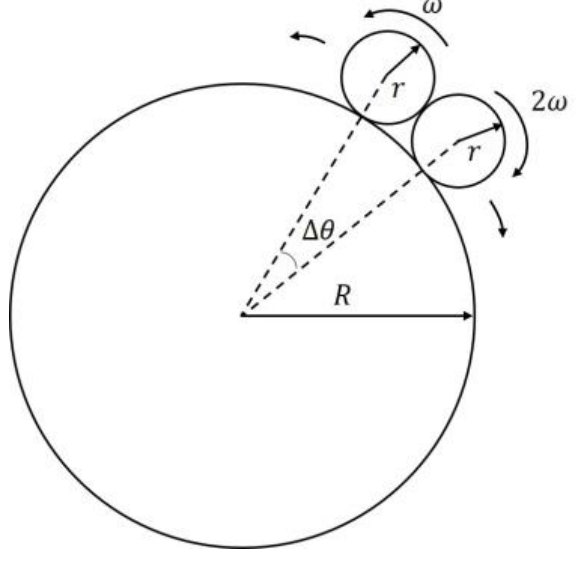
Consider a large disk of radius RR and two smaller disks, each of radius r=R/50r = R/50, lying on its circumference, as shown in the figure. The smaller disks are initially in contact with each other, with an angular separation Δθ\Delta\theta between their centers. They are made to roll without slipping in opposite directions, with constant angular velocities ω\omega and 2ω2\omega while the large disk is held stationary. The time τ\tau at which the smaller disks are again in contact is: [Use sin(Δθ)=Δθ\sin(\Delta\theta) = \Delta\theta and ignore gravity.]

Question Diagram 1

Options

A

τ=51×(2π451)/ω\tau = 51 \times \left(2\pi - \frac{4}{51}\right) / \omega

B

τ=51×(2π251)/3ω\tau = 51 \times \left(2\pi - \frac{2}{51}\right) / 3\omega

C

τ=51×(2π451)/3ω\tau = 51 \times \left(2\pi - \frac{4}{51}\right) / 3\omega

Correct
D

τ=51×(2π251)/ω\tau = 51 \times \left(2\pi - \frac{2}{51}\right) / \omega

Step-by-Step Solution

To find the time τ\tau at which the two smaller disks come into contact again, we analyze the geometric initial conditions and the kinematics of rolling without slipping.

1. Initial Angular Separation (Δθ\Delta\theta)

Let OO be the center of the large disk of radius RR. The radius of each small disk is r=R50r = \frac{R}{50}.

The centers C1C_1 and C2C_2 of the two small disks are at a distance of R+rR + r from OO: OC1=OC2=R+r=R+R50=5150R=51rOC_1 = OC_2 = R + r = R + \frac{R}{50} = \frac{51}{50}R = 51r

Since the two smaller disks are initially in contact, the distance between their centers is C1C2=2rC_1 C_2 = 2r. In the isosceles triangle ΔOC1C2\Delta OC_1C_2, the angle subtended at OO is Δθ\Delta\theta: sin(Δθ2)=C1C2/2OC1=rR+r=r51r=151\sin\left(\frac{\Delta\theta}{2}\right) = \frac{C_1 C_2 / 2}{OC_1} = \frac{r}{R+r} = \frac{r}{51r} = \frac{1}{51}

Using the given small-angle approximation sin(Δθ)Δθ\sin(\Delta\theta) \approx \Delta\theta, we get: Δθ2151    Δθ=251 rad\frac{\Delta\theta}{2} \approx \frac{1}{51} \implies \Delta\theta = \frac{2}{51}\text{ rad}


2. Relation Between Spin and Orbital Angular Velocities

Let ω1=ω\omega_1 = \omega and ω2=2ω\omega_2 = 2\omega be the spin angular velocities of the two disks about their respective centers.

For a disk rolling without slipping on a fixed circular path of radius RR, the speed vv of its center of mass is: v=rωspinv = r \omega_{\text{spin}}

The orbital angular velocity Ω\Omega of the center of mass about the center OO of the stationary large disk is related to vv by: v=(R+r)Ωv = (R + r)\Omega

Equating the two expressions for vv: (R+r)Ω=rωspin    Ω=rR+rωspin=r51rωspin=ωspin51(R + r)\Omega = r \omega_{\text{spin}} \implies \Omega = \frac{r}{R + r} \omega_{\text{spin}} = \frac{r}{51r} \omega_{\text{spin}} = \frac{\omega_{\text{spin}}}{51}

Thus, the orbital angular velocities of the centers of the two disks are: Ω1=ω51,Ω2=2ω51\Omega_1 = \frac{\omega}{51}, \quad \Omega_2 = \frac{2\omega}{51}


3. Condition for Recontact

Let the initial angular positions of the centers of disk 1 and disk 2 be θ1(0)=Δθ2\theta_1(0) = \frac{\Delta\theta}{2} and θ2(0)=Δθ2\theta_2(0) = -\frac{\Delta\theta}{2}, respectively.

Since they roll in opposite directions around the large disk, their angular positions at time tt are: θ1(t)=Δθ2+Ω1t\theta_1(t) = \frac{\Delta\theta}{2} + \Omega_1 t θ2(t)=Δθ2Ω2t\theta_2(t) = -\frac{\Delta\theta}{2} - \Omega_2 t

The disks come into contact again at time τ\tau when the angular separation between their centers becomes Δθ\Delta\theta on the opposite side of the circle: θ1(τ)θ2(τ)=2πΔθ\theta_1(\tau) - \theta_2(\tau) = 2\pi - \Delta\theta

Substituting θ1(τ)\theta_1(\tau) and θ2(τ)\theta_2(\tau): (Δθ2+Ω1τ)(Δθ2Ω2τ)=2πΔθ\left(\frac{\Delta\theta}{2} + \Omega_1 \tau\right) - \left(-\frac{\Delta\theta}{2} - \Omega_2 \tau\right) = 2\pi - \Delta\theta Δθ+(Ω1+Ω2)τ=2πΔθ\Delta\theta + (\Omega_1 + \Omega_2)\tau = 2\pi - \Delta\theta (Ω1+Ω2)τ=2π2Δθ(\Omega_1 + \Omega_2)\tau = 2\pi - 2\Delta\theta


4. Calculation of Time τ\tau

Substituting 2Δθ=2×251=4512\Delta\theta = 2 \times \frac{2}{51} = \frac{4}{51} and Ω1+Ω2=ω51+2ω51=3ω51\Omega_1 + \Omega_2 = \frac{\omega}{51} + \frac{2\omega}{51} = \frac{3\omega}{51}:

(3ω51)τ=2π451\left(\frac{3\omega}{51}\right)\tau = 2\pi - \frac{4}{51}

τ=51×(2π451)/3ω\tau = 51 \times \left(2\pi - \frac{4}{51}\right) / 3\omega

Thus, the correct option is C.

Time for Rolling Disks on Circular Path to Recontact | Physics PYQ Solution - JEE Challenger