Thermodynamic Reversible Processes on Internal Energy versus Entropy Plot
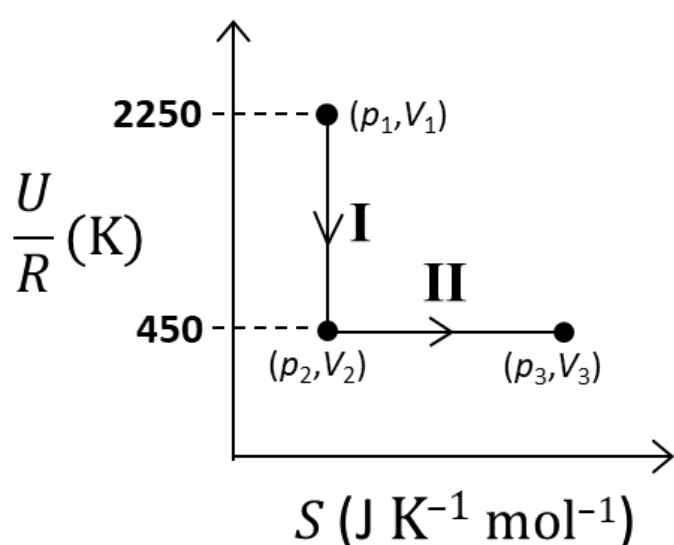
One mole of an ideal gas at undergoes two reversible processes, followed by , as depicted in the graph below. If the magnitude of work done by the gas in both processes is identical, find the value of .
(: internal energy, : entropy, : pressure, : volume, : gas constant)
(Given: molar heat capacity at constant volume, of the gas is )
Official Numerical Answer10
Topics & Concepts
Step-by-Step Solution
To find the value of , we analyze the two reversible processes depicted in the versus plot:
Process :
- This process is represented by a vertical line, meaning the entropy remains constant ().
- Therefore, Process is a reversible adiabatic process.
- From the graph, the initial internal energy is:
- The final internal energy for Process is:
- The temperature at state 2 is given by:
- For a reversible adiabatic process (), the work done by the gas () according to the First Law of Thermodynamics is:
Process :
- This process is represented by a horizontal line, meaning the internal energy is constant ().
- For an ideal gas, constant internal energy implies constant temperature (). Therefore, Process is a reversible isothermal process.
- The work done by the gas during this reversible isothermal expansion from volume to is:
Equating the work done in both processes: Since the magnitude of the work done by the gas in both processes is identical:
Thus, the value of is 10.