Thermodynamic Process Representation for First Law Formula
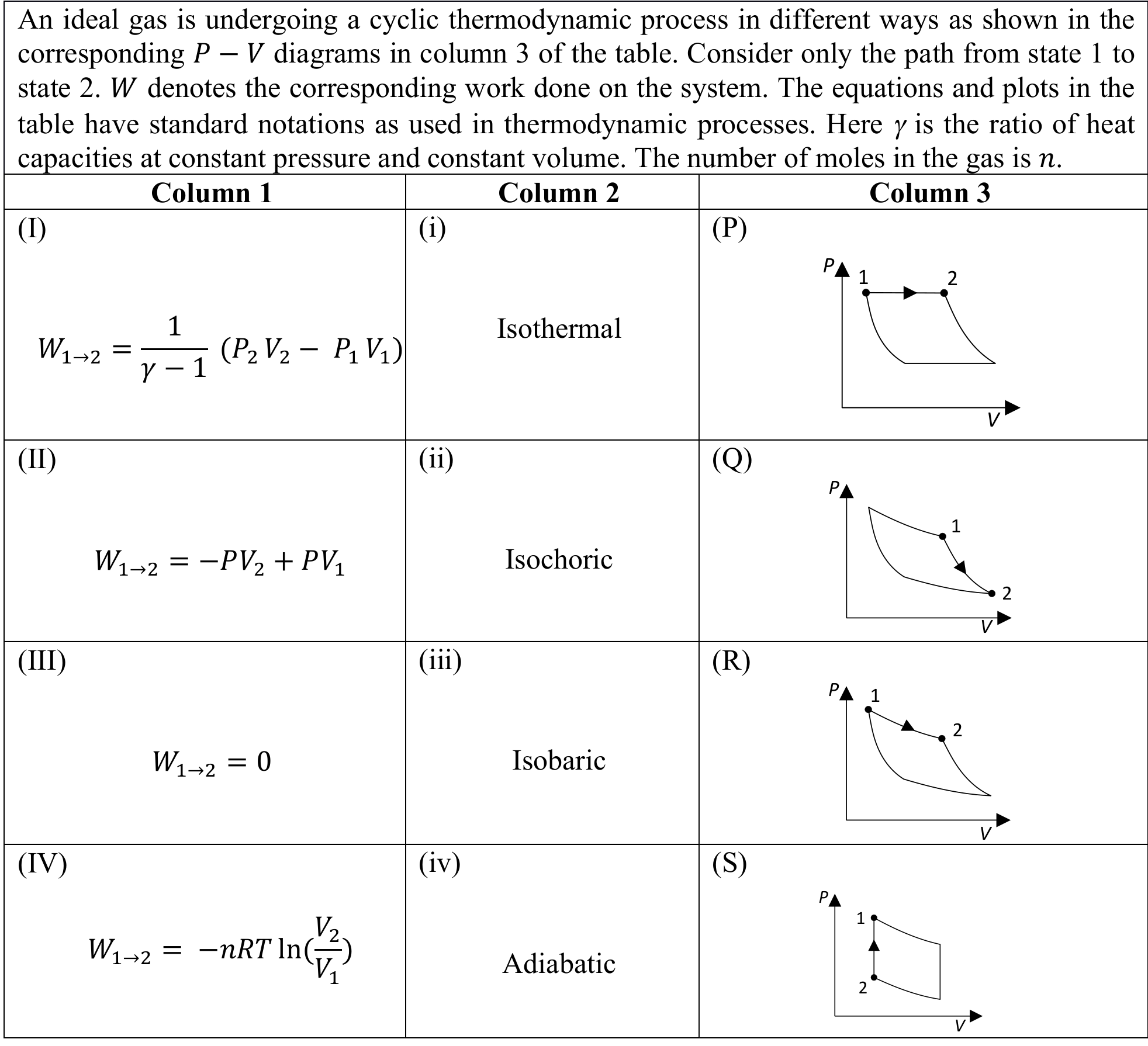
Answer questions 16, 17, and 18 by correctly matching the information given across the three columns in the following table.
An ideal gas undergoes a thermodynamic cyclic process along different paths as depicted in the corresponding diagrams in Column 3. Consider only the path from state 1 to state 2. Here, denotes the work done on the system. Standard notations are used for equations and plots in thermodynamics, where represents the ratio of specific heat capacities () and is the amount of gas in moles.
Which of the following choices gives the only valid representation of a process governed by ?
Options
(II) (iv) (R)
(III) (iii) (P)
(II) (iii) (S)
(II) (iii) (P)
Topics & Concepts
Step-by-Step Solution
To determine the correct representation of the thermodynamic process governed by the equation , we analyze the first law of thermodynamics and match the corresponding entries across the three columns.
-
First Law of Thermodynamics: The general statement of the First Law of Thermodynamics for a system is given by: where is the heat supplied to the system, is the change in internal energy, and is the work done on the system.
-
Matching Column 1: Comparing the given equation with the general First Law equation, we identify the work done on the system as: This expression directly corresponds to (II) in Column 1.
-
Matching Column 2: The work expression assumes a constant pressure during the transition from state 1 to state 2. A process occurring at constant pressure is defined as an Isobaric process. This corresponds to (iii) in Column 2.
-
Matching Column 3: On a diagram, an isobaric process moving from state 1 to state 2 is represented by a horizontal line (since pressure remains constant while volume changes).
- In diagram (P), path is a horizontal line indicating constant pressure, which represents an isobaric process.
- Diagram (Q) represents a curve (isothermal/adiabatic expansion).
- Diagram (R) represents a curve (isothermal/adiabatic expansion).
- Diagram (S) represents a vertical line (isochoric process at constant volume).
Therefore, diagram (P) correctly depicts the isobaric process.
Combining these matching entries yields:
Thus, the correct option is D.