JEE Challenger
More from Thermodynamics

Thermodynamic Process of Ideal Monoatomic Gas with Spring Loaded Piston

A sample of ideal monoatomic gas is enclosed within a horizontal cylindrical container fitted with a spring-loaded piston, as depicted in the diagram. Initially, the gas possesses a temperature T1T_1, pressure P1P_1, and volume V1V_1, while the spring remains in its uncompressed relaxed condition. The gas undergoes slow heating until reaching temperature T2T_2, pressure P2P_2, and volume V2V_2. During this expansion, the piston advances outward by a distance xx. Neglecting any frictional resistance between the piston and cylinder walls, select the valid statement(s):
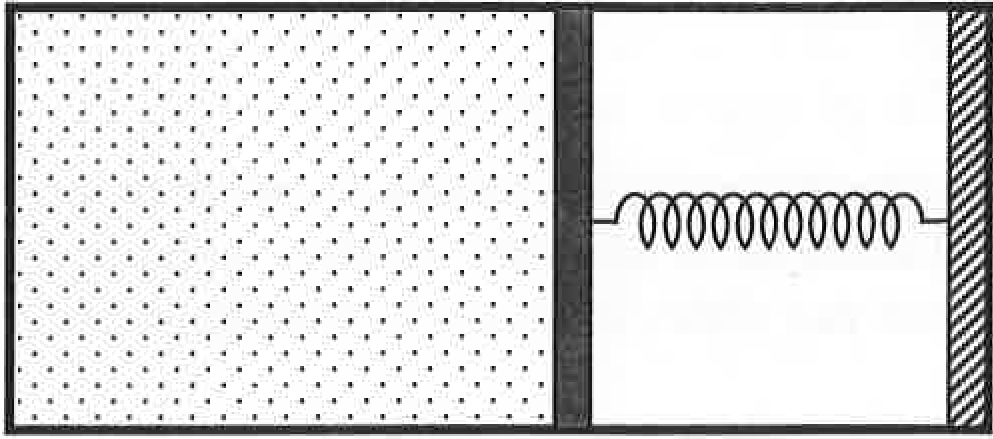
Question Diagram 1

Options

A

If V2=2V1V_2 = 2V_1 and T2=3T1T_2 = 3T_1, then the potential energy stored within the spring equals 14P1V1\frac{1}{4}P_1V_1

Correct
B

If V2=2V1V_2 = 2V_1 and T2=3T1T_2 = 3T_1, then the internal energy variation equals 3P1V13P_1V_1

Correct
C

If V2=3V1V_2 = 3V_1 and T2=4T1T_2 = 4T_1, then the work done by the gas equals 73P1V1\frac{7}{3}P_1V_1

Correct
D

If V2=3V1V_2 = 3V_1 and T2=4T1T_2 = 4T_1, then the heat supplied to the gas equals 176P1V1\frac{17}{6}P_1V_1

Step-by-Step Solution

To solve this problem, we analyze the thermodynamic process undergone by the ideal monoatomic gas enclosed in the cylinder with a spring-loaded piston.

1. General Governing Equations

Initially, the gas is in equilibrium at pressure P1P_1, volume V1V_1, and temperature T1T_1, with the spring in its relaxed state. Since the spring is uncompressed initially, the external atmospheric pressure acting on the piston is: Patm=P1P_{\text{atm}} = P_1

For a monoatomic ideal gas, the molar heat capacity at constant volume is: Cv=32RC_v = \frac{3}{2}R

The ideal gas equation at initial state gives: P1V1=nRT1P_1 V_1 = n R T_1

When the piston advances outward by displacement xx, the change in volume is: ΔV=V−V1=Ax  ⟹  x=V−V1A\Delta V = V - V_1 = A x \implies x = \frac{V - V_1}{A} where AA is the cross-sectional area of the piston.

The force balance on the piston at any volume VV gives the pressure of the gas: P⋅A=Patm⋅A+kxP \cdot A = P_{\text{atm}} \cdot A + k x P=P1+kA2(V−V1)=P1+C(V−V1)P = P_1 + \frac{k}{A^2} (V - V_1) = P_1 + C(V - V_1) where C=kA2C = \frac{k}{A^2} is a positive constant.


2. Analysis of Options (A) and (B)

Given conditions: V2=2V1andT2=3T1V_2 = 2V_1 \quad \text{and} \quad T_2 = 3T_1

Using the ideal gas state equation at state 2: P2V2P1V1=T2T1\frac{P_2 V_2}{P_1 V_1} = \frac{T_2}{T_1} P2(2V1)P1V1=3T1T1  ⟹  P2=32P1\frac{P_2 (2V_1)}{P_1 V_1} = \frac{3T_1}{T_1} \implies P_2 = \frac{3}{2} P_1

Using the linear pressure-volume relationship: P2=P1+C(V2−V1)P_2 = P_1 + C(V_2 - V_1) 32P1=P1+C(2V1−V1)  ⟹  CV1=12P1  ⟹  C=P12V1\frac{3}{2} P_1 = P_1 + C(2V_1 - V_1) \implies C V_1 = \frac{1}{2} P_1 \implies C = \frac{P_1}{2 V_1}

Potential energy stored in the spring:

Uspring=12kx2=12(kA2)(V2−V1)2=12C(V2−V1)2U_{\text{spring}} = \frac{1}{2} k x^2 = \frac{1}{2} \left(\frac{k}{A^2}\right) (V_2 - V_1)^2 = \frac{1}{2} C (V_2 - V_1)^2 Substituting C=P12V1C = \frac{P_1}{2 V_1} and V2−V1=V1V_2 - V_1 = V_1: Uspring=12(P12V1)(V1)2=14P1V1U_{\text{spring}} = \frac{1}{2} \left(\frac{P_1}{2 V_1}\right) (V_1)^2 = \frac{1}{4} P_1 V_1

Thus, Statement (A) is correct.

Change in internal energy (ΔU\Delta U):

ΔU=nCv(T2−T1)=n(32R)(3T1−T1)=3nRT1=3P1V1\Delta U = n C_v (T_2 - T_1) = n \left(\frac{3}{2} R\right) (3T_1 - T_1) = 3 n R T_1 = 3 P_1 V_1

Thus, Statement (B) is correct.


3. Analysis of Options (C) and (D)

Given conditions: V2=3V1andT2=4T1V_2 = 3V_1 \quad \text{and} \quad T_2 = 4T_1

Using the ideal gas state equation at state 2: P2V2P1V1=T2T1\frac{P_2 V_2}{P_1 V_1} = \frac{T_2}{T_1} P2(3V1)P1V1=4T1T1  ⟹  P2=43P1\frac{P_2 (3V_1)}{P_1 V_1} = \frac{4T_1}{T_1} \implies P_2 = \frac{4}{3} P_1

Using the linear pressure-volume relationship: P2=P1+C(V2−V1)P_2 = P_1 + C(V_2 - V_1) 43P1=P1+C(3V1−V1)=P1+2CV1  ⟹  2CV1=13P1  ⟹  C=P16V1\frac{4}{3} P_1 = P_1 + C(3V_1 - V_1) = P_1 + 2 C V_1 \implies 2 C V_1 = \frac{1}{3} P_1 \implies C = \frac{P_1}{6 V_1}

Work done by the gas (WW):

Since PP varies linearly with VV, the work done is equal to the area of the trapezoid under the P−VP-V graph: W=P1+P22(V2−V1)W = \frac{P_1 + P_2}{2} (V_2 - V_1) Substituting P2=43P1P_2 = \frac{4}{3} P_1 and V2−V1=2V1V_2 - V_1 = 2 V_1: W=P1+43P12(2V1)=73P1V1W = \frac{P_1 + \frac{4}{3} P_1}{2} (2 V_1) = \frac{7}{3} P_1 V_1

Thus, Statement (C) is correct.

Heat supplied to the gas (QQ):

By the First Law of Thermodynamics: Q=ΔU+WQ = \Delta U + W

First, calculating ΔU\Delta U: ΔU=nCv(T2−T1)=n(32R)(4T1−T1)=92nRT1=92P1V1\Delta U = n C_v (T_2 - T_1) = n \left(\frac{3}{2} R\right) (4T_1 - T_1) = \frac{9}{2} n R T_1 = \frac{9}{2} P_1 V_1

Now calculating QQ: Q=92P1V1+73P1V1=(27+146)P1V1=416P1V1Q = \frac{9}{2} P_1 V_1 + \frac{7}{3} P_1 V_1 = \left(\frac{27 + 14}{6}\right) P_1 V_1 = \frac{41}{6} P_1 V_1

Thus, Statement (D) is incorrect.


Conclusion

The correct statements are A, B, and C.