Thermodynamic Process of Ideal Monoatomic Gas under Compression and Thermal Equilibrium
Ten moles of an ideal monoatomic gas, initially in state at atmospheric pressure and temperature , is enclosed in a metal cylinder of volume fitted with a frictionless piston. The gas is suddenly compressed to state with volume . Now, keeping the piston stationary, the cylinder is submerged in a water bath of temperature until the gas reaches the temperature of the water bath, which is denoted as state . Finally, while still in the water bath, the piston is brought slowly to its initial position, which is denoted as state . If is universal gas constant, then the correct option(s) is/are: [Given: ]
Options
The schematic P-V diagram of the processes described above is:
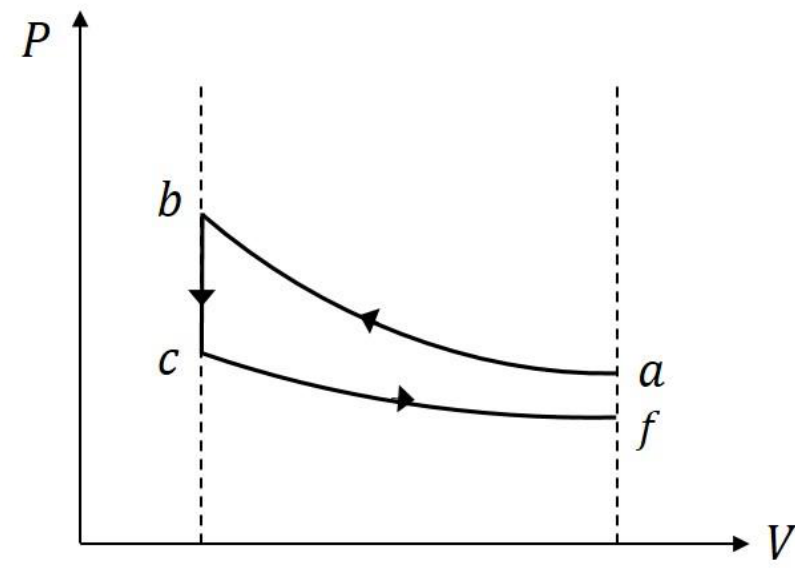
The change in internal energy in going from state to is .
The net change in the internal energy in the whole process is .
The pressure and temperature of the state are times the atmospheric pressure and , respectively.
Topics & Concepts
Step-by-Step Solution
To determine the correct options, let us analyze each process step-by-step.
1. Initial State ()
- Number of moles:
- Monoatomic gas: ,
- Initial volume:
- Initial temperature:
- Initial pressure: (atmospheric pressure)
2. Process (Sudden Compression)
A sudden compression is a rapid thermodynamic process where heat exchange with the surroundings is negligible, making it an adiabatic process ().
- Final volume:
- Using the adiabatic relation :
Given :
-
Using the adiabatic relation :
-
The change in internal energy ():
-
Analysis of Option B: . (Correct)
-
Analysis of Option D: The temperature at state is , but the pressure is (not ). (Incorrect)
3. Process (Isochoric Cooling)
- The piston is held stationary, so (Isochoric process).
- The cylinder is submerged in a water bath at until equilibrium is reached:
- On the diagram, this is represented by a vertical line going downward from to as pressure drops at constant volume.
4. Process (Slow Isothermal Expansion)
- The piston is brought slowly back to its initial position while inside the water bath.
- Since the process is slow and in thermal contact with the bath, it is an isothermal process at .
5. Net Change in Internal Energy ()
Since internal energy is a state function depending only on temperature:
- Analysis of Option C: Net change in internal energy is . (Correct)
6. P-V Diagram (Option A)
- : Adiabatic curve compression from to (pressure increases).
- : Isochoric vertical line downwards from to at .
- : Isothermal curve expansion from to (pressure decreases).
This perfectly matches the schematic shown in option A.
- Analysis of Option A: (Correct)
Conclusion
The correct options are A, B, and C.