Thermodynamic Cycle Efficiency of Monoatomic Gas
A quasi-static cycle of a monoatomic ideal gas contains an isothermal process (), followed by an isochoric process () and an adiabatic process () as shown in the figure. The volumes of the gas are and at and , respectively. If the cycle has heat input and output , then the efficiency of the cycle is defined as . The correct statement(s) is/are: [Given: ]
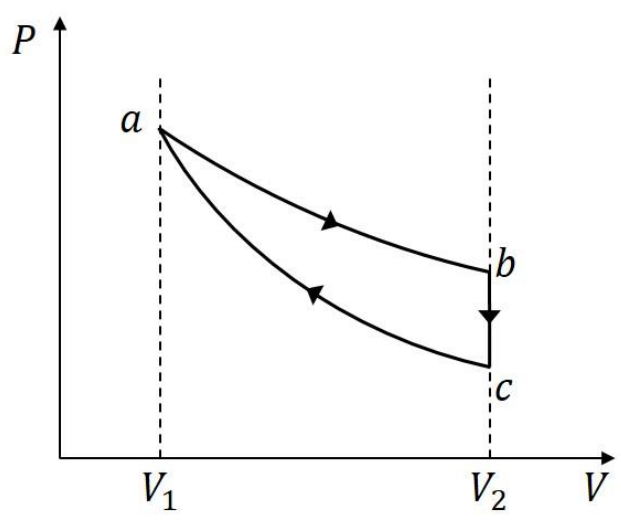
Options
If , the heat released in the process is smaller than the heat absorbed in the process .
For a given value of , does not depend on the temperature of the isothermal process.
If , then the temperature of the gas at is 4 times the temperature of the gas at .
If , then the pressure of the gas at is 4 times the pressure of the gas at .
Topics & Concepts
Step-by-Step Solution
To analyze the given thermodynamic cycle for a monatomic ideal gas (, ), let us examine each process step-by-step:
1. Analysis of Processes:
-
Process (Isothermal Expansion): The gas expands isothermally at temperature . The heat absorbed during this process is:
-
Process (Isochoric Cooling): The gas is cooled at constant volume from temperature to . The heat released during this process is:
-
Process (Adiabatic Compression): The gas undergoes adiabatic compression from back to . Using the relation for an adiabatic process, : Since the gas is monatomic, :
2. Verification of Options:
-
Option C: Given : Thus, the temperature at is 4 times the temperature at . Statement (C) is correct.
-
Option D: Given : Thus, the pressure at is 8 times the pressure at , not 4 times. Statement (D) is incorrect.
-
Option A: For : Comparing the two heat values: Therefore, the heat released in is smaller than the heat absorbed in . Statement (A) is correct.
-
Option B: The efficiency of the cycle is given by: Substituting : Since cancels out completely, depends only on the volume ratio and is independent of the isothermal temperature. Statement (B) is correct.
Conclusion:
The correct statements are A, B, and C.