Terminal Velocity and Equilibrium of Connected Spheres Floating in Viscous Liquids
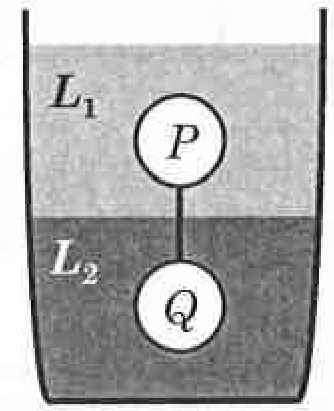
Two spheres and having identical radii possess densities and , respectively. These spheres are connected via a light massless string and placed inside two fluids and with densities and along with viscosities and , respectively. In static equilibrium, sphere floats in and sphere floats in , with the connecting string held taut (refer to figure). When sphere alone is placed in , its terminal velocity is , while sphere alone placed in achieves terminal velocity . Which of the following relationship(s) is/are correct?
Options
Topics & Concepts
Step-by-Step Solution
To determine the correct relationships, let us analyze the equilibrium of the system and the motion of each sphere independently.
1. Equilibrium of the Connected Spheres
Let be the volume and be the radius of each sphere.
For the two-liquid system in static equilibrium:
- Liquid floats on top of liquid , which implies .
- Sphere is in liquid and sphere is in liquid .
- The connecting string is taut, so the tension .
For sphere (in liquid ): The forces acting on it are:
- Buoyant force upward:
- Weight downward:
- Tension downward:
Equating the vertical forces:
Since , we have:
For sphere (in liquid ): The forces acting on it are:
- Buoyant force upward:
- Weight downward:
- Tension upward:
Equating the vertical forces:
Since , we have:
Equating the expressions for tension :
2. Terminal Velocities of the Spheres
Case 1: Sphere alone in liquid Since , we have . Thus, the buoyant force on in exceeds its weight, causing sphere to move vertically upwards. At terminal velocity , the viscous drag force balances the net upward buoyant force:
Case 2: Sphere alone in liquid Since , we have . Thus, the weight of sphere exceeds the buoyant force in , causing sphere to move vertically downwards. At terminal velocity , the viscous drag force balances the net downward force:
3. Comparing the Terminal Velocities
Using equation (1), , we can take the ratio of the magnitudes of the terminal velocities:
Since points vertically upward and points vertically downward, the two velocity vectors are in opposite directions. Therefore:
Thus, the correct options are A and D.