JEE Challenger
More from Amines

Synthesis Methods for Benzyl Isocyanide Preparation

Benzyl isocyanide can be obtained from

Choose the correct answer from the options given below:

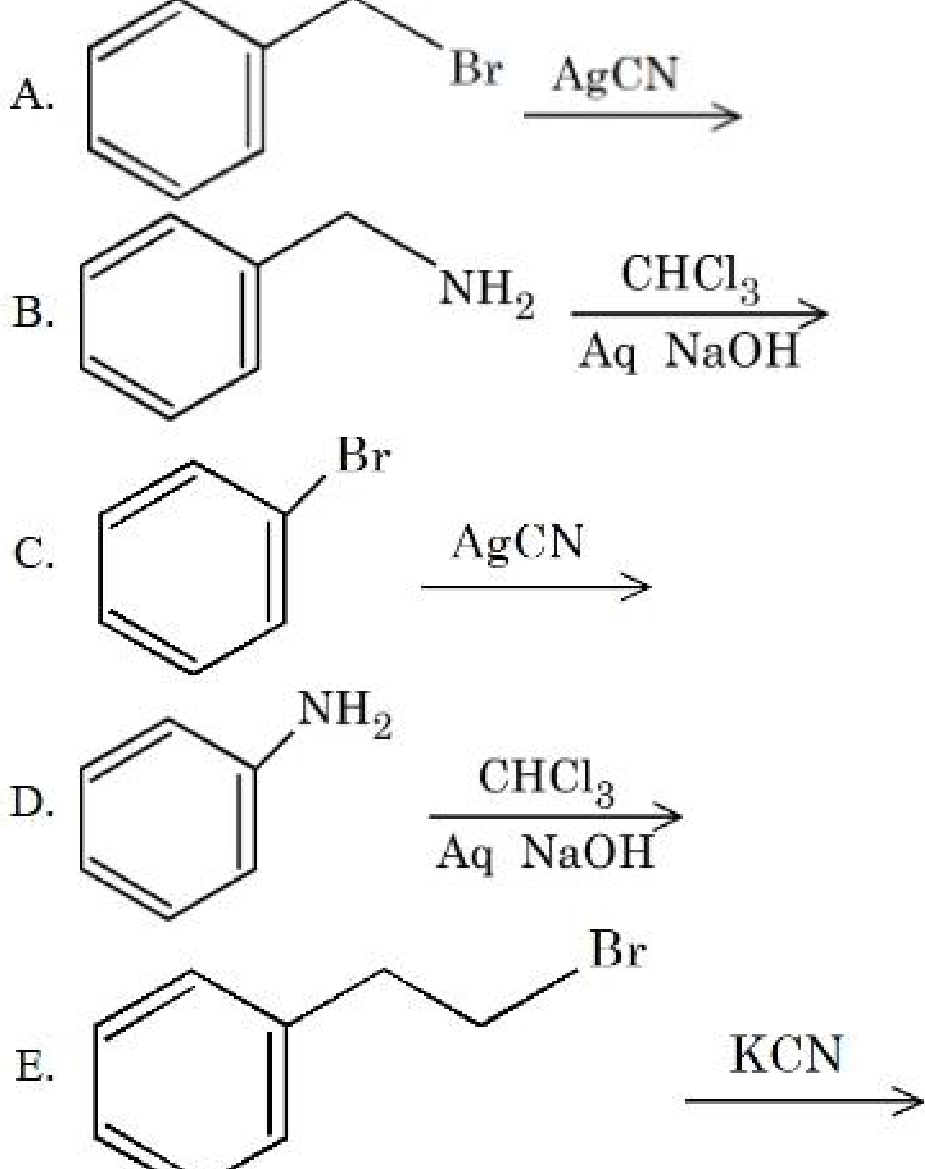
Question Diagram 1

Options

A

A and B Only

Correct
B

A and C Only

C

B and D Only

D

D and E Only

Topics & Concepts

Step-by-Step Solution

To determine which reactions yield benzyl isocyanide (C6H5CH2NC\text{C}_6\text{H}_5\text{CH}_2\text{NC}), let us analyze each of the given chemical reactions:

  1. Reaction A: C6H5CH2Br+AgCNC6H5CH2NC+AgBr\text{C}_6\text{H}_5\text{CH}_2\text{Br} + \text{AgCN} \longrightarrow \text{C}_6\text{H}_5\text{CH}_2\text{NC} + \text{AgBr}

    • Mechanism: Silver cyanide (AgCN\text{AgCN}) is predominantly covalent in nature. As a result, the lone pair of electrons on the nitrogen atom acts as the nucleophile rather than the carbon atom.
    • Product: Reaction of benzyl bromide (C6H5CH2Br\text{C}_6\text{H}_5\text{CH}_2\text{Br}) with AgCN\text{AgCN} yields benzyl isocyanide (C6H5CH2NC\text{C}_6\text{H}_5\text{CH}_2\text{NC}) as the major product.
  2. Reaction B: C6H5CH2NH2+CHCl3+3NaOHC6H5CH2NC+3NaCl+3H2O\text{C}_6\text{H}_5\text{CH}_2\text{NH}_2 + \text{CHCl}_3 + 3\text{NaOH} \longrightarrow \text{C}_6\text{H}_5\text{CH}_2\text{NC} + 3\text{NaCl} + 3\text{H}_2\text{O}

    • Mechanism: This is the Carbylamine reaction (Isocyanide test). Primary amines react with chloroform (CHCl3\text{CHCl}_3) in the presence of a base (NaOH\text{NaOH}) via a dichlorocarbene (: ⁣CCl2:\!\text{CCl}_2) intermediate.
    • Product: Benzylamine (C6H5CH2NH2\text{C}_6\text{H}_5\text{CH}_2\text{NH}_2) is a primary amine and produces benzyl isocyanide (C6H5CH2NC\text{C}_6\text{H}_5\text{CH}_2\text{NC}).
  3. Reaction C: C6H5Br+AgCNC6H5NC+AgBr\text{C}_6\text{H}_5\text{Br} + \text{AgCN} \longrightarrow \text{C}_6\text{H}_5\text{NC} + \text{AgBr}

    • Product: Reaction of bromobenzene with AgCN\text{AgCN} yields phenyl isocyanide (C6H5NC\text{C}_6\text{H}_5\text{NC}), not benzyl isocyanide.
  4. Reaction D: C6H5NH2+CHCl3+3NaOHC6H5NC+3NaCl+3H2O\text{C}_6\text{H}_5\text{NH}_2 + \text{CHCl}_3 + 3\text{NaOH} \longrightarrow \text{C}_6\text{H}_5\text{NC} + 3\text{NaCl} + 3\text{H}_2\text{O}

    • Product: Aniline (C6H5NH2\text{C}_6\text{H}_5\text{NH}_2) undergoes the carbylamine reaction to form phenyl isocyanide (C6H5NC\text{C}_6\text{H}_5\text{NC}), not benzyl isocyanide.
  5. Reaction E: C6H5CH2CH2Br+KCNC6H5CH2CH2CN+KBr\text{C}_6\text{H}_5\text{CH}_2\text{CH}_2\text{Br} + \text{KCN} \longrightarrow \text{C}_6\text{H}_5\text{CH}_2\text{CH}_2\text{CN} + \text{KBr}

    • Product: Potassium cyanide (KCN\text{KCN}) is ionic, so nucleophilic attack occurs through the carbon atom to yield a nitrile (cyanide), namely 3-phenylpropanenitrile (C6H5CH2CH2CN\text{C}_6\text{H}_5\text{CH}_2\text{CH}_2\text{CN}).

Thus, A and B Only produce benzyl isocyanide.

Correct Answer: A and B Only (Option A)
Synthesis Methods for Benzyl Isocyanide Preparation | Chemistry PYQ Solution - JEE Challenger