Structure of Dichloromethyl Phenolate Intermediate
Reimer-Tiemann reaction introduces an aldehyde group onto the aromatic ring of phenol, ortho to the hydroxyl group. This reaction involves electrophilic aromatic substitution. This is a general method for the synthesis of substituted salicylaldehydes as depicted below:
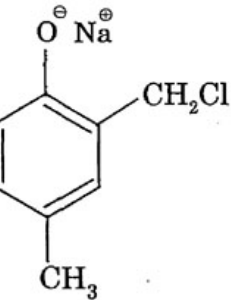
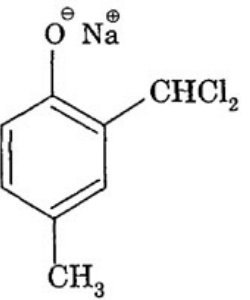
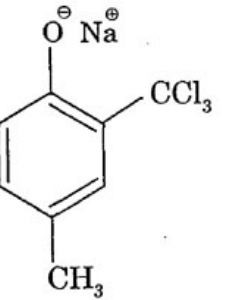
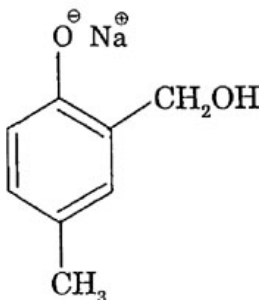
The structure of the intermediate is
Options
Step-by-Step Solution
Electrophilic attack of dichlorocarbene () occurs at the activated ortho position of the phenoxide ion derived from -cresol.
Aromatization via proton transfer yields a benzal chloride derivative having an group, a group at the para position, and a group at the ortho position.
Subsequent hydrolysis of this gem-dichloride intermediate during the acidic workup generates the target aldehyde ().
Thus, intermediate is the sodium phenolate bearing at C-2 and at C-4, which corresponds exactly to Option B.
Correct Answer: B