Structure of D Aldotetrose Forming Optically Inactive Dicarboxylic Acid
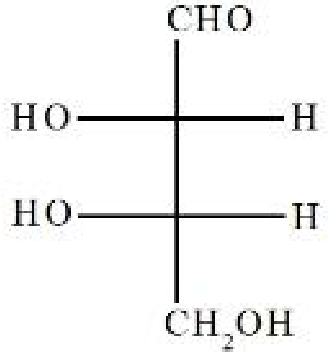
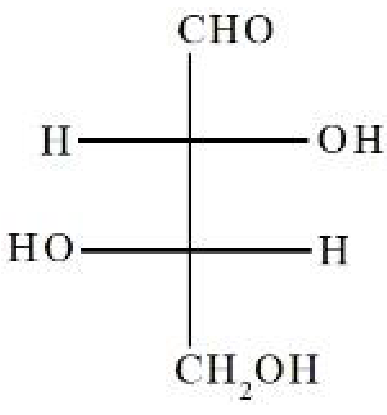
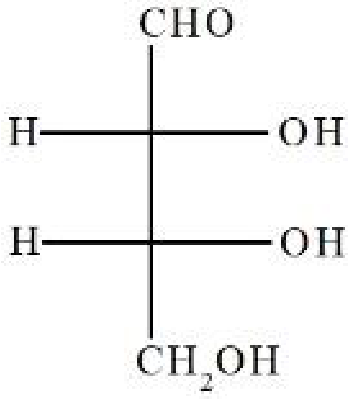
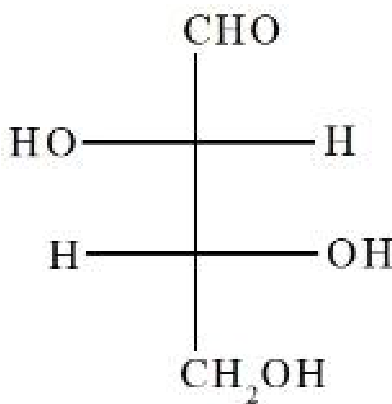
A D-aldotetrose on oxidation with concentrated resulted in optically inactive dicarboxylic acid. The structure of the D-aldotetrose is:
Options
Topics & Concepts
Step-by-Step Solution
To determine the correct structure of the D-aldotetrose, we analyze the configuration and the optical activity of the oxidation product step-by-step:
1. D-Configuration Criterion
In a Fischer projection, an aldotetrose is classified as a D-sugar if the hydroxyl group () on the highest-numbered chiral carbon () is directed to the right.
- Option A: has on the left L-erythrose
- Option B: has on the left L-threose
- Option C: has on the right D-erythrose
- Option D: has on the right D-threose
Thus, only options C and D represent D-aldotetroses.
2. Oxidation Reaction with Concentrated
Concentrated nitric acid () is a strong oxidizing agent. It oxidizes both the terminal aldehyde group () at and the primary alcohol group () at into carboxylic acid () groups, forming an aldaric acid (tartaric acid derivative).
3. Optical Activity of the Oxidation Products
-
Oxidation of Option C (D-erythrose):
The resulting dicarboxylic acid is meso-tartaric acid. This molecule possesses a horizontal plane of symmetry passing between and . Due to this internal symmetry, it is achiral and optically inactive.
-
Oxidation of Option D (D-threose):
The resulting dicarboxylic acid lacks a plane of symmetry or center of inversion, making it chiral and optically active.
Conclusion
The D-aldotetrose that gives an optically inactive dicarboxylic acid upon oxidation with concentrated is D-erythrose, shown in Option C.
Correct Answer: C