Stopping Potential versus Frequency Graph for Photosensitive Metals
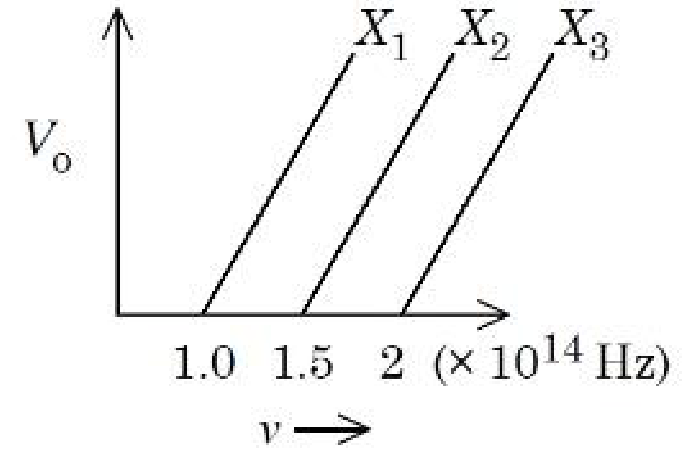
The graph shows variation of stopping potential with the frequency of the incident radiation for three photosensitive metals , and . Which metal will give out electrons with greater kinetic energy, for the same wavelength of incident radiation?
Options
All the metals will give out photo electrons with same kinetic energies.
Topics & Concepts
Step-by-Step Solution
To determine which metal will emit photoelectrons with the greatest kinetic energy for incident radiation of the same wavelength, we use Einstein's photoelectric equation:
where:
- is the maximum kinetic energy of the emitted photoelectrons,
- is Planck's constant,
- is the frequency of the incident radiation,
- is the work function of the photosensitive metal.
The relationship between stopping potential and incident frequency is expressed as:
At the threshold frequency , the stopping potential , giving:
From the provided graph of versus :
- Threshold frequency for metal :
- Threshold frequency for metal :
- Threshold frequency for metal :
Since , the work functions satisfy:
For a given wavelength of incident radiation, the photon energy is constant for all three metals. The maximum kinetic energy is:
Since has the smallest work function , it yields the maximum kinetic energy:
Hence, metal will give out electrons with greater kinetic energy.
Correct Option: A ()