Stereochemistry of Hydroxylation of Isomers of Dicarboxylic Acid
Consider and as isomers of dicarboxylic acid . Both decolorize . Upon heating, forms a cyclic anhydride.
Treatment with dilute alkaline allows as well as to produce one or more compounds from and .
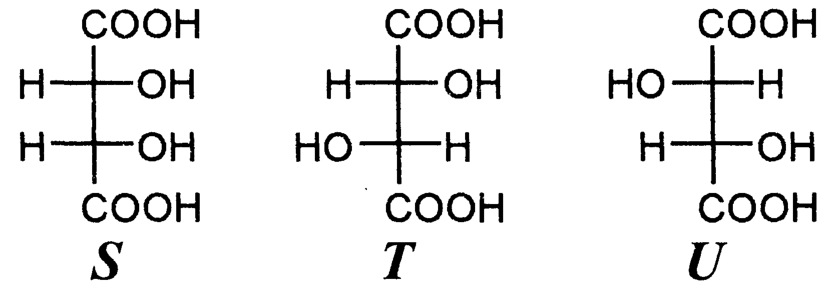
Identify the compounds generated from and , respectively:
Options
Optically active and optically active pair ()
Optically inactive and optically inactive pair ()
Optically active pair () and optically active
Optically inactive pair () and optically inactive
Step-by-Step Solution
To determine the products formed from compounds and , we analyze their structures and the stereochemistry of the hydroxylation reaction step-by-step:
1. Identification of Compounds and
The molecular formula has a degree of unsaturation (DU) equal to: Since and are dicarboxylic acids, two degrees of unsaturation belong to the two carbonyl groups (), and the remaining one degree of unsaturation corresponds to a carbon-carbon double bond ().
- Compound forms a cyclic anhydride upon heating, which requires the two carboxyl groups to be in close proximity (cis-configuration). Thus, is maleic acid (cis-butenedioic acid).
- Compound is the geometrical isomer of , which is fumaric acid (trans-butenedioic acid).
2. Nature of the Reaction
Treatment with dilute alkaline (Baeyer's reagent) results in -hydroxylation across the alkene double bond, adding two groups from the same face.
3. Stereochemical Outcome of the Reaction
Reaction of (cis-isomer):
- Applying the stereochemical rule for additions:
- The syn-hydroxylation of maleic acid () yields meso-tartaric acid, which corresponds to structure :
- Structure contains a plane of symmetry bisecting the bond and is internally compensated. Therefore, is optically inactive.
Reaction of (trans-isomer):
- Applying the stereochemical rule for additions:
- The syn-hydroxylation of fumaric acid () yields an equimolar pair of enantiomers, -tartaric acid and -tartaric acid, represented by structures and :
- Since an equal mixture of and is formed, the resulting pair constitutes a racemic mixture, which is optically inactive due to external compensation.
Conclusion
- Reaction of produces optically inactive .
- Reaction of produces optically inactive pair ().
Thus, the correct option is B.