Stability of Carbocation and Carbanion with Resonance Effects
Given below are two statements :
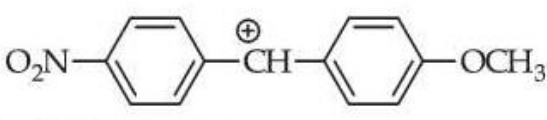
Statement I : In , the carbocation is stabilised by effect of group.
Statement II : In , the carbanion is stabilised by effect of group.
In the light of the above statements, choose the correct answer from the options given below :

Options
ACorrect
Both Statement I and Statement II are true
B
Both Statement I and Statement II are false
C
Statement I is true but Statement II is false
D
Statement I is false but Statement II is true
Topics & Concepts
Step-by-Step Solution
To determine the correctness of Statements I and II, let us analyze the resonance effects present in both species:
1. Analysis of Statement I
- Structure:
- The central carbon atom is a carbocation with a vacant -orbital ( hybridized).
- The group attached at the para-position relative to the carbocation contains unshared lone pairs on the oxygen atom.
- The oxygen atom donates its lone pair of electrons via resonance ( effect) through the conjugated -system of the benzene ring into the empty -orbital of the carbocation:
- This leads to a canonical form where all atoms (including carbon) possess a complete octet of electrons, providing immense thermodynamic stabilization to the carbocation.
Thus, Statement I is true.
2. Analysis of Statement II
- Structure:
- The central carbon atom is a carbanion bearing a negative charge and a lone pair of electrons.
- The nitro group () attached at the para-position is a powerful electron-withdrawing group by resonance ( effect).
- The negative charge on the central carbanion delocalizes through the -system of the benzene ring directly onto the electronegative oxygen atoms of the nitro group:
- Delocalizing the excess electron density onto the oxygen atoms significantly lowers the energy and stabilizes the carbanion.
Thus, Statement II is true.
Conclusion
Both Statement I and Statement II are correct statements.
Correct Option: A (Both Statement I and Statement II are true)