Spring Mass Pulley System Acceleration and Maximum Extension
Consider a block of mass attached to a massless spring with spring constant . This block is connected to two other blocks having masses and via two massless pulleys and strings. The accelerations of the blocks are and as illustrated in the figure. The system is released from rest when the spring is in its unstretched state. The maximum extension attained by the spring is . Which of the following option(s) is/are correct? [ denotes acceleration due to gravity. Ignore friction]
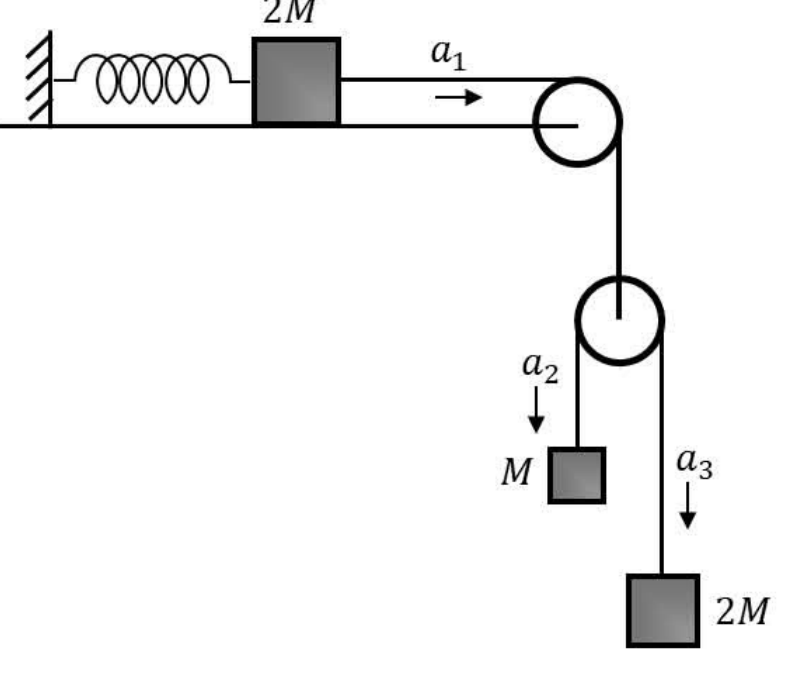
Options
When the spring attains an extension of for the first time, the speed of the block attached to the spring is
At an extension of of the spring, the magnitude of acceleration of the block connected to the spring is
Topics & Concepts
Step-by-Step Solution
To determine which option(s) is/are correct, we analyze the system using kinematics and dynamics.
1. Kinematic Constraint (Option D)
Let be the horizontal displacement of the block of mass connected to the spring.
Since string 1 is inextensible, the downward displacement of the lower (movable) pulley is equal to . Thus, the downward acceleration of the lower pulley is .
Let and be the downward displacements of the blocks of mass and attached to the lower pulley, respectively. Their downward accelerations are and .
The total length of string 2 passing over the lower pulley is:
Differentiating this constraint equation twice with respect to time:
Thus, Option D is correct.
2. Dynamic Equations and Maximum Extension (Option A)
Let be the tension in string 1 attached to the block of mass , and be the tension in string 2 holding masses and .
Since the lower pulley is massless:
The equations of motion for the suspended blocks are:
- For mass :
- For mass :
where is the acceleration of the blocks relative to the lower pulley.
Subtracting the equation for mass from the equation for mass :
Substituting back into the force equation for mass :
Thus, tension is:
Now, applying Newton's second law to the block of mass on the horizontal surface (with displacement and acceleration ):
Solving for acceleration :
This equation represents Simple Harmonic Motion with an equilibrium extension where :
Since the system is released from rest at , the maximum extension is:
Thus, Option A is incorrect.
3. Speed of the Block at (Option B)
At , the speed of the block attached to the spring reaches its maximum value:
where:
Substituting these values:
Thus, Option B is incorrect.
4. Acceleration at (Option C)
At , the magnitude of the acceleration of the block connected to the spring is:
Thus, Option C is incorrect.
Conclusion
The only correct option is D.