Speed of Inelastic Block Striking Second Inclined Plane
Paragraph for Question Nos. 44 to 46
A small block of mass moves on a frictionless surface of an inclined plane, as shown in figure.
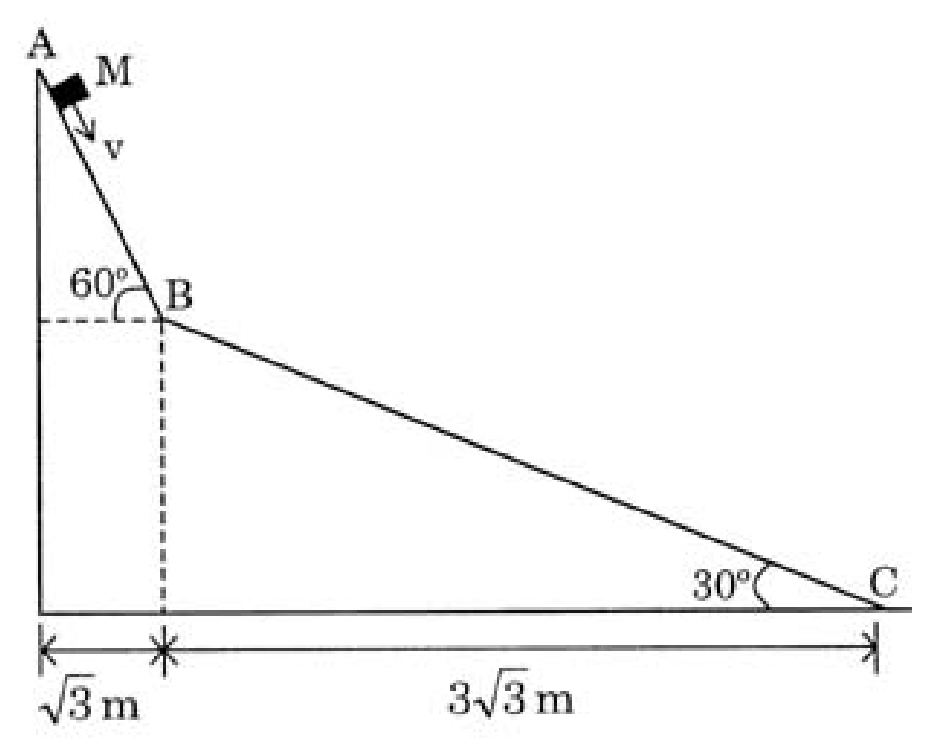
The angle of the incline suddenly changes from to at point . The block is initially at rest at . Assume that collisions between the block and the incline are totally inelastic ().
The speed of the block at point immediately after it strikes the second incline is
Options
Topics & Concepts
Step-by-Step Solution
To find the speed of the block at point immediately after it strikes the second incline, we proceed in two steps:
Step 1: Speed of the block just before striking the second incline at point
The first inclined plane makes an angle of with the horizontal, and the horizontal span under it is .
The vertical height through which the block descends from point to point is:
Since the incline is frictionless and the block starts from rest at , by the conservation of mechanical energy:
Here, is directed along the first incline, at an angle of below the horizontal.
Step 2: Collision with the second incline at point
The second incline makes an angle of with the horizontal. Therefore, the angle between the first incline and the second incline is:
During the impact at , the impulsive normal force exerted by the second incline acts perpendicular to the surface of the second incline. Because the surface is frictionless, there is no impulsive force along the direction parallel to the second incline.
Furthermore, the collision is given to be completely inelastic, which means the component of velocity perpendicular to the second incline becomes zero immediately after impact:
The component of velocity parallel to the second incline is conserved during the impact:
Substituting the values:
Therefore, the speed of the block immediately after it strikes the second incline is , which corresponds to Option (B).