JEE Challenger
More from Waves

Sound Wavelength Interference In Narrow Tube Configurations

\textbf{List-I} shows four configurations made of straight and semi-circular narrow tubes containing air. A sound wave of wavelength λ=0.29 m\lambda = 0.29\text{ m} enters these structures at the point SS and a sound detector is placed at DD. Between the points SS and DD, the sound travels only through the tubes. \textbf{List-II} contains the possible smallest values of ll (refer to the figures) for which the detector DD records maximum amplitude. Ignore effects of sharp corners. [Given cos(15)=0.97\cos(15^\circ) = 0.97]

Choose the option that best describes the match between the entries in \textbf{List-I} to those in \textbf{List-II}.
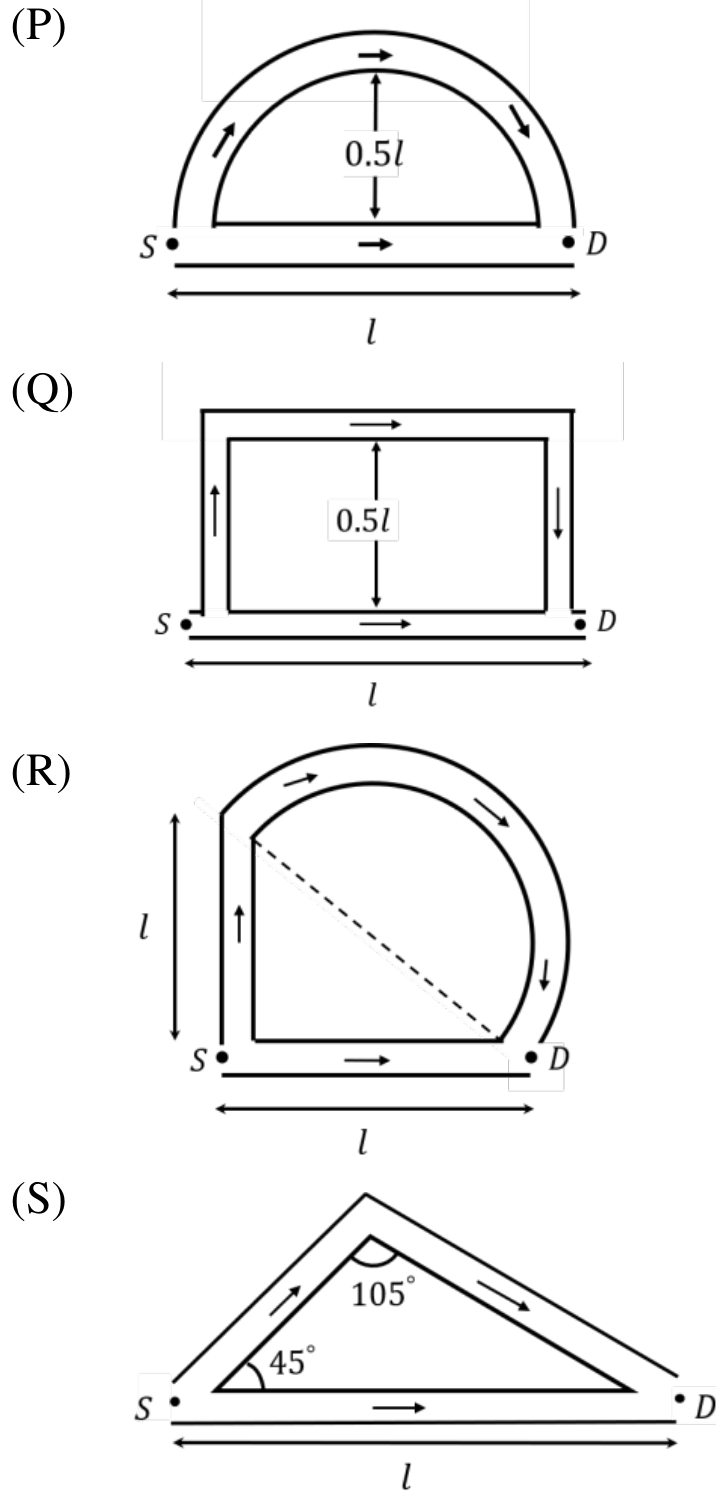
List-IList-II(P)(1) 1.32 m(Q)(2) 1.19 m(R)(3) 0.51 m(S)(4) 0.29 m(5) 0.13 m\begin{array}{|l|l|} \hline \textbf{List-I} & \textbf{List-II} \\ \hline \text{(P)} & \text{(1) } 1.32\text{ m} \\ \text{(Q)} & \text{(2) } 1.19\text{ m} \\ \text{(R)} & \text{(3) } 0.51\text{ m} \\ \text{(S)} & \text{(4) } 0.29\text{ m} \\ & \text{(5) } 0.13\text{ m} \\ \hline \end{array}
Question Diagram 1

Options

A

P4,Q3,R5,S1\text{P}\rightarrow 4, \text{Q}\rightarrow 3, \text{R}\rightarrow 5, \text{S}\rightarrow 1

B

P4,Q3,R1,S5\text{P}\rightarrow 4, \text{Q}\rightarrow 3, \text{R}\rightarrow 1, \text{S}\rightarrow 5

C

P3,Q4,R1,S2\text{P}\rightarrow 3, \text{Q}\rightarrow 4, \text{R}\rightarrow 1, \text{S}\rightarrow 2

D

P3,Q4,R5,S2\text{P}\rightarrow 3, \text{Q}\rightarrow 4, \text{R}\rightarrow 5, \text{S}\rightarrow 2

Correct

Step-by-Step Solution

To find the conditions for maximum amplitude recorded by detector DD, the two sound waves traveling along different tube paths from source SS to detector DD must interfere constructively. Constructive interference occurs when the path difference Δx\Delta x between the two sound routes is an integral multiple of the wavelength λ\lambda:

Δx=nλwhere n=1,2,3,\Delta x = n\lambda \quad \text{where } n = 1, 2, 3, \dots

Given λ=0.29 m\lambda = 0.29\text{ m}, we consider n=1n = 1 to find the smallest non-zero value of ll for each configuration.


1. Configuration (P)

  • Direct path length: x1=lx_1 = l
  • Upper path length: The straight tube between SS and DD has length ll, which serves as the diameter of the upper semi-circular tube. Thus, the radius is R=0.5lR = 0.5l. x2=πR=0.5πlx_2 = \pi R = 0.5\pi l
  • Path difference: Δx=x2x1=(0.5π1)l\Delta x = x_2 - x_1 = (0.5\pi - 1) l
  • Constructive interference condition (n=1n = 1): (0.5π1)l=λ(0.5\pi - 1) l = \lambda (0.5×3.14161)l=0.29    0.5708l=0.29(0.5 \times 3.1416 - 1) l = 0.29 \implies 0.5708 l = 0.29 l=0.290.57080.51 ml = \frac{0.29}{0.5708} \approx 0.51\text{ m}

Hence, P3\text{P} \rightarrow 3.


2. Configuration (Q)

  • Direct path length: x1=lx_1 = l
  • Upper path length: The upper route consists of a vertical segment of height 0.5l0.5l, a horizontal segment of length ll, and a vertical segment of height 0.5l0.5l. x2=0.5l+l+0.5l=2lx_2 = 0.5l + l + 0.5l = 2l
  • Path difference: Δx=x2x1=2ll=l\Delta x = x_2 - x_1 = 2l - l = l
  • Constructive interference condition (n=1n = 1): l=λ=0.29 ml = \lambda = 0.29\text{ m}

Hence, Q4\text{Q} \rightarrow 4.


3. Configuration (R)

  • Direct path length: x1=lx_1 = l
  • Upper path length: The wave goes vertically upwards by a distance ll to a top vertex AA, and then travels along a semi-circular tube from AA to DD. The diameter of this semi-circular section is the straight line distance AD=l2+l2=2lAD = \sqrt{l^2 + l^2} = \sqrt{2}l. x2=l+π(2l2)=(1+π2)lx_2 = l + \pi \left(\frac{\sqrt{2}l}{2}\right) = \left(1 + \frac{\pi}{\sqrt{2}}\right) l
  • Path difference: Δx=x2x1=π2l\Delta x = x_2 - x_1 = \frac{\pi}{\sqrt{2}} l
  • Constructive interference condition (n=1n = 1): π2l=λ    l=2λπ=1.4142×0.293.14160.13 m\frac{\pi}{\sqrt{2}} l = \lambda \implies l = \frac{\sqrt{2}\lambda}{\pi} = \frac{1.4142 \times 0.29}{3.1416} \approx 0.13\text{ m}

Hence, R5\text{R} \rightarrow 5.


4. Configuration (S)

  • Direct path length: x1=lx_1 = l

  • Upper path length: The path forms a triangle SADSAD with base SD=lSD = l, interior angle at S=45S = 45^\circ, and interior angle at A=105A = 105^\circ. The remaining angle at DD is 18010545=30180^\circ - 105^\circ - 45^\circ = 30^\circ.

    Applying the Law of Sines on SAD\triangle SAD: SAsin30=ADsin45=lsin105\frac{SA}{\sin 30^\circ} = \frac{AD}{\sin 45^\circ} = \frac{l}{\sin 105^\circ} Using sin105=cos15=0.97\sin 105^\circ = \cos 15^\circ = 0.97: x2=SA+AD=l(sin30+sin45)sin105=l(0.5+0.7071)0.971.2444lx_2 = SA + AD = \frac{l (\sin 30^\circ + \sin 45^\circ)}{\sin 105^\circ} = \frac{l (0.5 + 0.7071)}{0.97} \approx 1.2444 l

  • Path difference: Δx=x2x1=(1.24441)l=0.2444l\Delta x = x_2 - x_1 = (1.2444 - 1) l = 0.2444 l

  • Constructive interference condition (n=1n = 1): 0.2444l=λ=0.29    l=0.290.24441.19 m0.2444 l = \lambda = 0.29 \implies l = \frac{0.29}{0.2444} \approx 1.19\text{ m}

Hence, S2\text{S} \rightarrow 2.


Conclusion

The correct matching between List-I and List-II is: P3,Q4,R5,S2\text{P}\rightarrow 3, \quad \text{Q}\rightarrow 4, \quad \text{R}\rightarrow 5, \quad \text{S}\rightarrow 2

This matches Option D.

Sound Wavelength Interference In Narrow Tube Configurations | Physics PYQ Solution - JEE Challenger