Separation Between Images Formed in Square Water Container
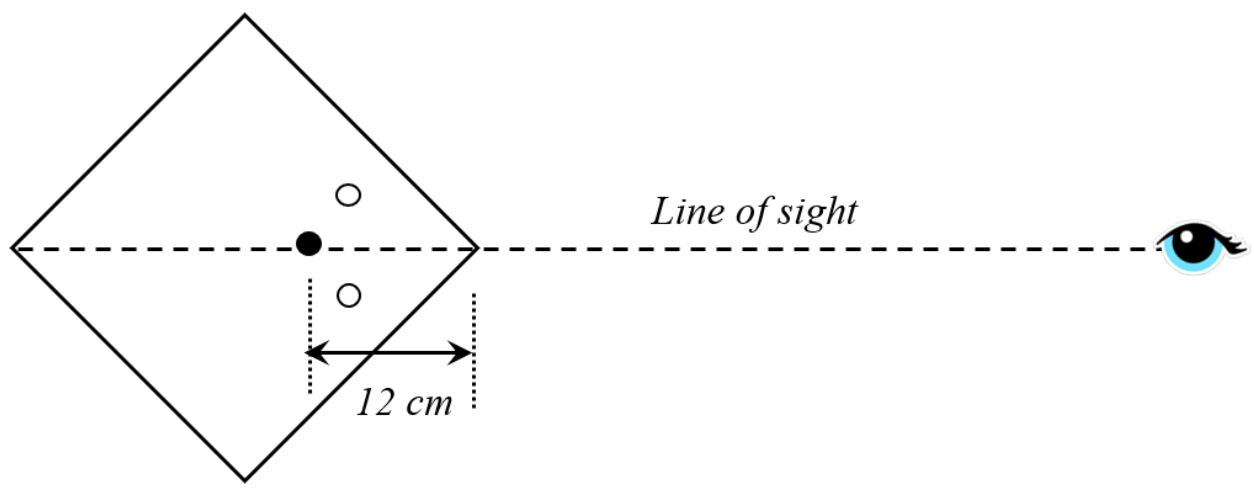
Consider a large square container with thin transparent vertical walls containing water placed on a flat horizontal table. A student holds a thin straight wire vertically in the water at a distance of from one corner, as illustrated schematically in the figure. Observing the wire from this corner, another student views two images of the wire positioned symmetrically on either side of the line of sight. Find the distance of separation (in cm) between these two images.
Topics & Concepts
Step-by-Step Solution
To find the distance of separation between the two images formed by refraction at the two adjacent transparent walls of the square container, we analyze the problem geometrically.
1. Geometry of the Setup
- The container has vertical walls meeting at a corner.
- The observer views the wire along the line of sight, which is the diagonal (angle bisector) of the corner.
- The wire is situated inside the water (refractive index ) along this diagonal at a distance from the corner.
- The diagonal makes an angle of with each of the two adjacent walls meeting at the corner.
2. Distance from the Wire to the Container Walls
The perpendicular distance of the wire from either of the two mutually perpendicular walls is given by:
3. Apparent Shift due to Refraction
When light rays from the wire pass through one of the flat transparent walls into air (), the apparent perpendicular distance of the image from that wall is reduced due to refraction:
Thus, the shift of the image towards the wall (along the normal to the wall) is:
4. Component of Shift Perpendicular to the Line of Sight
Since the wall's normal makes an angle of with the line of sight, the component of this normal shift perpendicular to the line of sight is:
5. Separation Between the Two Images
Refraction at the two adjacent walls forms two images located symmetrically on opposite sides of the line of sight. Each image is displaced by away from the line of sight.
Therefore, the total distance of separation between the two images is:
Final Answer: The distance of separation between the two images is 3 cm.