Selective Reduction of Ester and Carboxylic Acid Groups
Considering reduces an ester group to the corresponding alcohol and does not reduce a carboxylic acid group, the correct statement about the major products , , and is
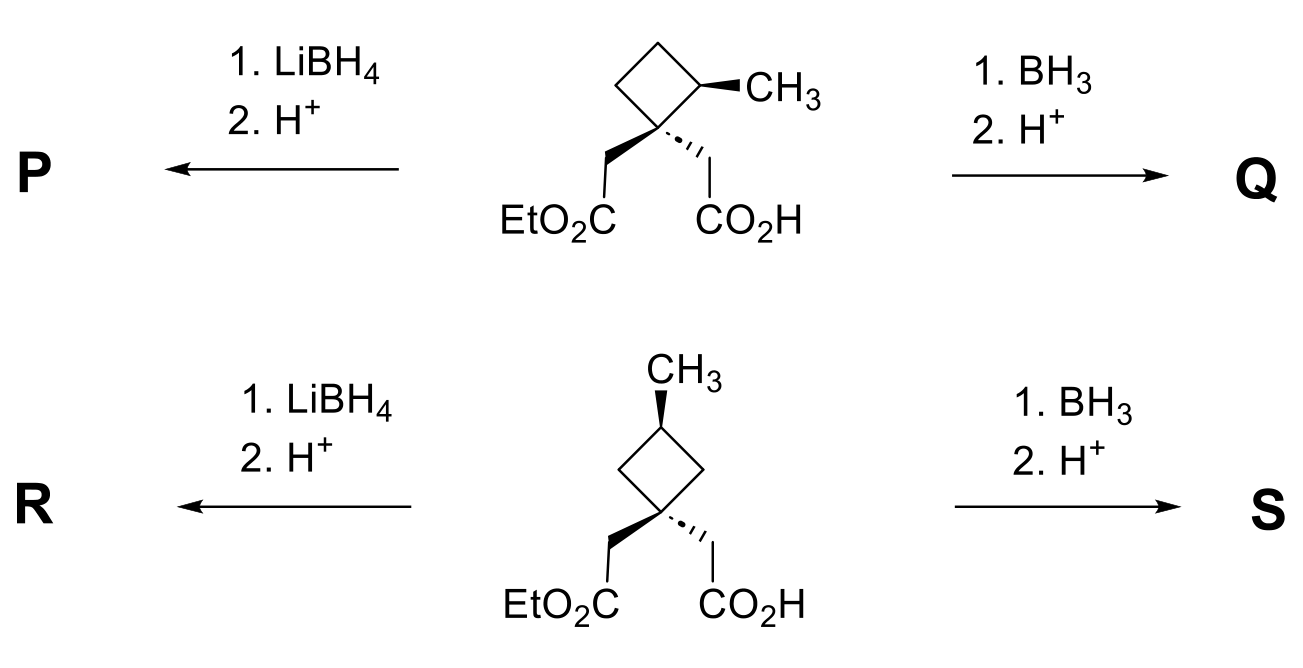
Options
& are identical, and & are diastereomers.
& are diastereomers, and & are identical.
& are diastereomers, and & are diastereomers.
& are identical, and & are identical.
Step-by-Step Solution
To determine the relationship between the major products , , , and , we analyze the chemoselectivity of the reducing agents and the resulting stereochemistry of the products.
1. Chemoselectivity of the Reagents
-
Lithium Borohydride ():
- Chemoselectively reduces the ester group () to a primary alcohol group ().
- It leaves the carboxylic acid group () unreacted under standard conditions:
-
Borane ():
- Chemoselectively reduces the carboxylic acid group () to a primary alcohol group ().
- It reacts much faster with carboxylic acids than with esters, leaving the ester group () unreacted:
2. Analysis of Products and
In the first starting material:
-
The methyl group () is present on a wedge.
-
At the substituted carbon position, the ester group () is on a wedge, and the carboxylic acid group () is on a dash.
-
Formation of ():
- The ester group () on the wedge is reduced to (wedge).
- The acid group () on the dash remains unchanged.
- Thus, in , the group is cis to the group.
-
Formation of ():
- The carboxylic acid group () on the dash is reduced to (dash).
- The ester group () on the wedge remains unchanged.
- Thus, in , the group is trans to the group.
Since and are non-superimposable stereoisomers that are not mirror images of each other (due to differing cis/trans spatial arrangements of functional groups relative to the fixed methyl group), and are diastereomers.
3. Analysis of Products and
In the second starting material:
-
The methyl group () is again on a wedge.
-
The ester group () is on a wedge, and the carboxylic acid group () is on a dash.
-
Formation of ():
- The ester group () on the wedge is reduced to (wedge).
- In product , the group is cis to the group.
-
Formation of ():
- The carboxylic acid group () on the dash is reduced to (dash).
- In product , the group is trans to the group.
Similarly, and differ in their relative configuration (cis vs. trans relationship), making and diastereomers.
Conclusion
- and are diastereomers.
- and are diastereomers.
Hence, the correct option is C.