JEE Challenger
More from System of Particles and Rotational Motion

Rotations Completed by Coin Tossed Vertically with Off Center Impulse

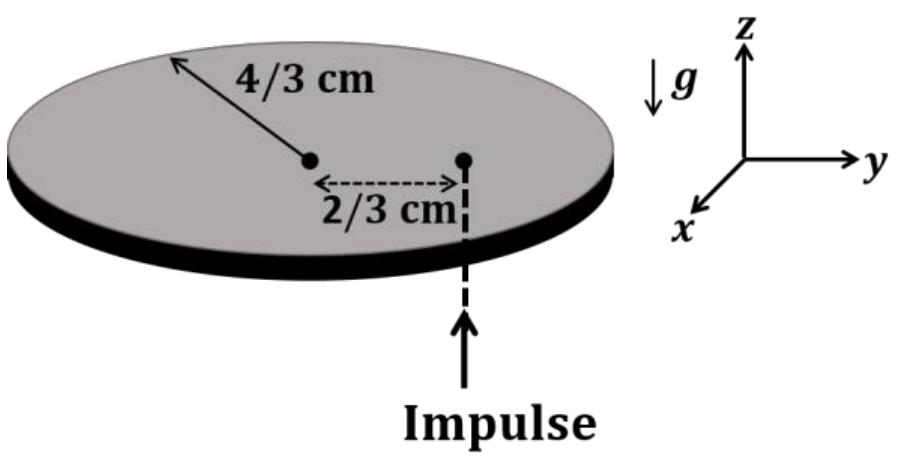
A thin circular coin of mass 5 gm5\text{ gm} and radius 4/3 cm4/3\text{ cm} is initially in a horizontal xyxy-plane. The coin is tossed vertically up (+z+z direction) by applying an impulse of π2×10² N-s\sqrt{\frac{\pi}{2}} \times 10^{-2}\text{ N-s} at a distance 2/3 cm2/3\text{ cm} from its center. The coin spins about its diameter and moves along the +z+z direction. By the time the coin reaches back to its initial position, it completes nn rotations. The value of nn is ______.

[Given: The acceleration due to gravity g=10 m s2g = 10\text{ m s}^{-2}]

Question Diagram 1
Official Numerical Answer30

Step-by-Step Solution

To find the number of rotations nn completed by the coin, we need to determine its angular velocity ω\omega and the time of flight TT.

1. Initial Linear Velocity and Time of Flight: The impulse JJ applied to the coin imparts a linear momentum to its center of mass along the +z+z direction: J=mv0J = m v_0

Given:

  • Mass m=5 g=5×10³ kgm = 5\text{ g} = 5 \times 10^{-3}\text{ kg}
  • Impulse J=π2×10² NsJ = \sqrt{\frac{\pi}{2}} \times 10^{-2}\text{ N}\cdot\text{s}

Thus, the initial linear velocity v0v_0 is: v0=Jm=π2×1025×103=2π m s1v_0 = \frac{J}{m} = \frac{\sqrt{\frac{\pi}{2}} \times 10^{-2}}{5 \times 10^{-3}} = \sqrt{2\pi}\text{ m s}^{-1}

The time of flight TT for the coin to return to its initial position under the acceleration due to gravity (g=10 m s2g = 10\text{ m s}^{-2}) is given by: T=2v0g=22π10=2π5 sT = \frac{2 v_0}{g} = \frac{2 \sqrt{2\pi}}{10} = \frac{\sqrt{2\pi}}{5}\text{ s}

2. Angular Velocity: The impulse is applied at a distance r=23 cmr = \frac{2}{3}\text{ cm} from the center of the coin. The angular impulse ΔL\Delta L about the diameter perpendicular to the position vector of the impulse application point is: ΔL=Jr\Delta L = J \cdot r

The moment of inertia of a uniform circular coin of radius R=43 cm=43×102 mR = \frac{4}{3}\text{ cm} = \frac{4}{3} \times 10^{-2}\text{ m} about its diameter is: I=14mR2I = \frac{1}{4} m R^2

Since the coin starts from rest (ω0=0\omega_0 = 0), the angular velocity ω\omega imparted to it is: Iω=JrI \omega = J \cdot r (14mR2)ω=Jr\left(\frac{1}{4} m R^2\right) \omega = J \cdot r

Substitute r=R2r = \frac{R}{2} since r=23 cmr = \frac{2}{3}\text{ cm} and R=43 cmR = \frac{4}{3}\text{ cm}: 14mR2ω=JR2    ω=2JmR\frac{1}{4} m R^2 \omega = J \cdot \frac{R}{2} \implies \omega = \frac{2 J}{m R}

Using v0=Jmv_0 = \frac{J}{m}: ω=2v0R\omega = \frac{2 v_0}{R}

3. Total Rotations Completed: The total angular displacement θ\theta completed by the time the coin returns to its initial position is: θ=ωT=(2v0R)(2v0g)=4v02gR\theta = \omega T = \left(\frac{2 v_0}{R}\right) \left(\frac{2 v_0}{g}\right) = \frac{4 v_0^2}{g R}

Substitute v02=2πv_0^2 = 2\pi, g=10 m s2g = 10\text{ m s}^{-2}, and R=43×102 mR = \frac{4}{3} \times 10^{-2}\text{ m}: θ=4(2π)10×(43×102)=8π430=60π rad\theta = \frac{4 (2\pi)}{10 \times \left(\frac{4}{3} \times 10^{-2}\right)} = \frac{8\pi}{\frac{4}{30}} = 60\pi\text{ rad}

The number of complete rotations nn is: n=θ2π=60π2π=30n = \frac{\theta}{2\pi} = \frac{60\pi}{2\pi} = 30

Rotations Completed by Coin Tossed Vertically with Off Center Impulse | Physics PYQ Solution - JEE Challenger