Resonant Frequency of Circuit with Concentric Coupled Coils
Consider a circuit consisting of a capacitor of capacitance and a coil with turns per unit length, cross sectional area and length , where . There is another coil of length , cross sectional area and turns per unit length completely inside the larger coil, as shown in the figure. The ends of this smaller coil are connected with each other by an insulated conducting wire. The self-inductance of the larger coil is . Neglecting edge effects and all the Ohmic resistances, the resonant frequency of the circuit is:
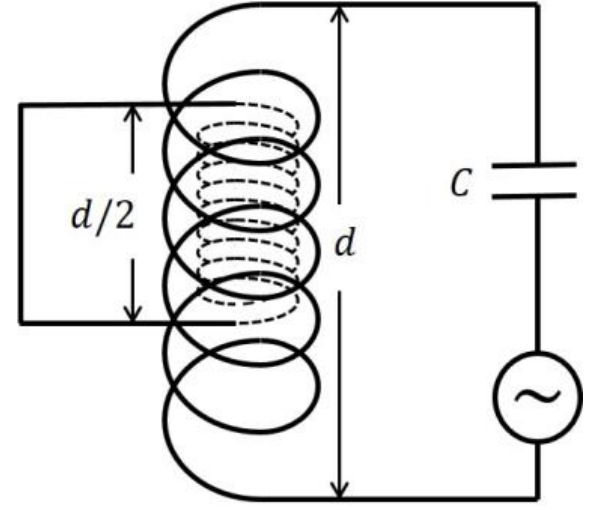
Options
Topics & Concepts
Step-by-Step Solution
To find the resonant frequency of the circuit, we first determine the self-inductance of both coils and the mutual inductance between them.
1. Self-Inductance of the Larger Coil ()
For the larger coil (coil 1):
- Number of turns per unit length:
- Total length:
- Cross-sectional area:
The self-inductance of coil 1 is given by:
2. Self-Inductance of the Smaller Coil ()
For the smaller coil (coil 2):
- Number of turns per unit length:
- Total length:
- Cross-sectional area:
The self-inductance of coil 2 is given by:
3. Mutual Inductance ()
Since the smaller coil is completely inside the larger coil, the magnetic field produced by current flowing in coil 1 is uniform inside it:
The total magnetic flux linked with coil 2 due to coil 1 is:
Thus, the mutual inductance between the two coils is:
4. Effective Inductance of the System ()
The ends of the smaller coil are short-circuited (neglecting resistance), so the induced potential difference across coil 2 is zero:
Substituting and :
The potential drop across coil 1 (the main circuit loop) is:
Substituting , , and :
Therefore, the effective inductance of the larger coil connected in the circuit is:
5. Resonant Frequency
The resonant frequency of the circuit is given by:
Thus, the correct option is C.