Resistance of a Thin Square Conducting Sheet
Consider a thin square sheet of side and thickness , made of a material of resistivity . The resistance between two opposite faces, shown by the shaded areas in the figure is
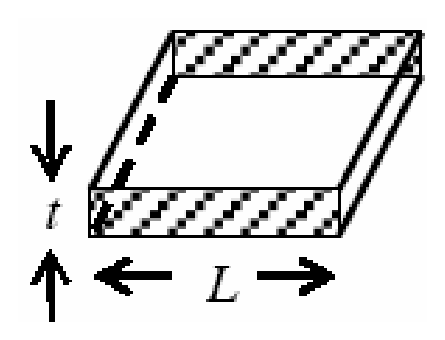
Options
directly proportional to
directly proportional to
independent of
independent of
Topics & Concepts
Step-by-Step Solution
To find the resistance between the two opposite shaded faces of the thin square sheet:
-
Identify the length of the conductor along the direction of current flow:
The current flows from one shaded face across the sheet to the opposite shaded face. The distance traversed by the current is the length of the side of the square:
-
Determine the cross-sectional area perpendicular to the current flow:
The face through which the current enters (and leaves) has a width of and a thickness of . Therefore, the cross-sectional area is:
-
Calculate the resistance ():
Using the formula for electrical resistance in terms of resistivity , length , and cross-sectional area :
From this result, we see that the resistance :
- Is inversely proportional to the thickness .
- Is completely independent of the side length .
Thus, the resistance is independent of .
Correct Option: C