Refraction Through Two Isosceles Prisms and Plane Mirror
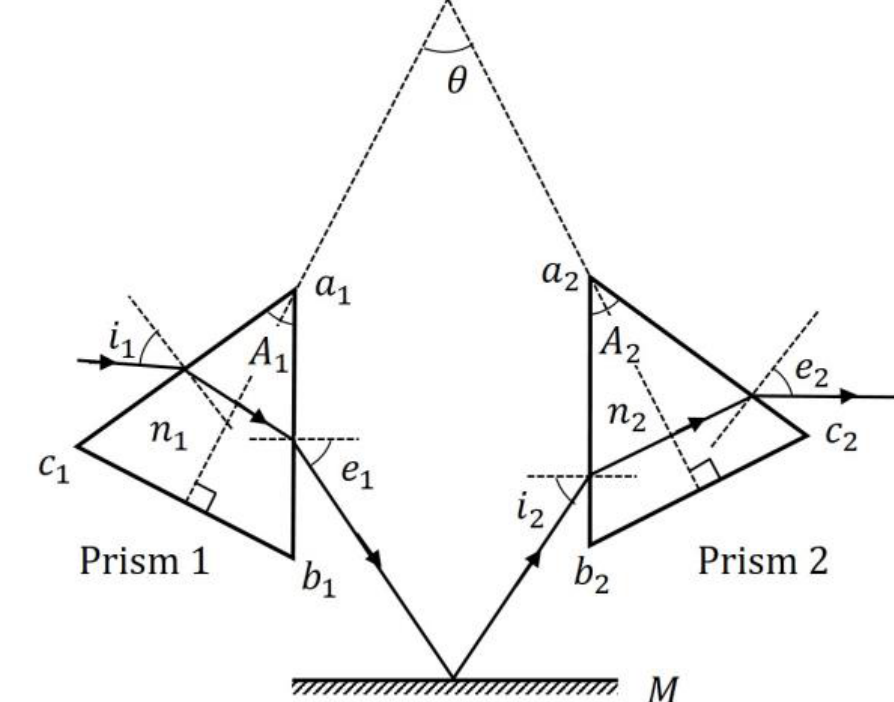
Consider two isosceles prisms 1 and 2 with prism angles and and refractive indices and , respectively, as shown in the figure. The faces and are parallel to each other and perpendicular to the mirror . If a ray of light is incident on the face and emerges from the face , then the correct statement(s) is/are:
Options
If both the prisms are at minimum deviation condition, then .
If prism 2 is at minimum deviation condition, then is always true.
If both the prisms 1 and 2 are thin and are at minimum deviation condition with angles of deviation and , respectively, then .
If prism 1 is at minimum deviation condition, then is always true.
Topics & Concepts
Step-by-Step Solution
To analyze the given optical setup, we first use geometric optics to find the relationship between the angles of light propagation through the two prisms and the plane mirror .
1. Geometric Relation Between Prisms 1 and 2
- The faces and are given to be parallel to each other and perpendicular to the plane mirror .
- Taking the plane of mirror to be horizontal, the normals to the faces and are both horizontal.
- Let a ray of light emerge from face of Prism 1 at an angle of emergence with respect to the normal of face . The ray thus makes an angle with the horizontal.
- The ray reflects off the horizontal plane mirror . By the law of reflection, the angle of the reflected ray with the horizontal remains .
- Since the normal to face of Prism 2 is also horizontal, the angle of incidence at face must be equal to the angle of emergence from face :
2. Analysis of Option A
For Prism 1 at minimum deviation condition:
- The angle of refraction at the internal surface is .
- Applying Snell's law at the emerging face :
For Prism 2 at minimum deviation condition:
- The angle of refraction at the internal surface is .
- Applying Snell's law at the incident face :
Since , we have , which yields:
Thus, Option A is correct.
3. Analysis of Option D
If Prism 1 is at minimum deviation condition, we have:
Using the relation , it directly follows that:
This relation holds universally whenever Prism 1 is at minimum deviation, regardless of the parameters or state of Prism 2.
Thus, Option D is correct.
4. Analysis of Option B
If Prism 2 is at minimum deviation condition, we have:
For to hold, we would require , which is only true if Prism 1 is also at minimum deviation condition. Since Prism 1 is not specified to be at minimum deviation, this statement is not always true.
Thus, Option B is incorrect.
5. Analysis of Option C
- The face is vertical and forms an angle with face .
- The face is vertical and forms an angle with face .
- Since , the angle between the extended surfaces and is given by:
For a full thin isosceles prism with minimum deviation angle , the angle of deviation is related to the half-angle by , which gives:
Substituting and into the expression for :
Thus, Option C is correct.
Conclusion
The correct options are A, C, and D.