Refraction and Total Internal Reflection in Prism Inside Rectangular Block
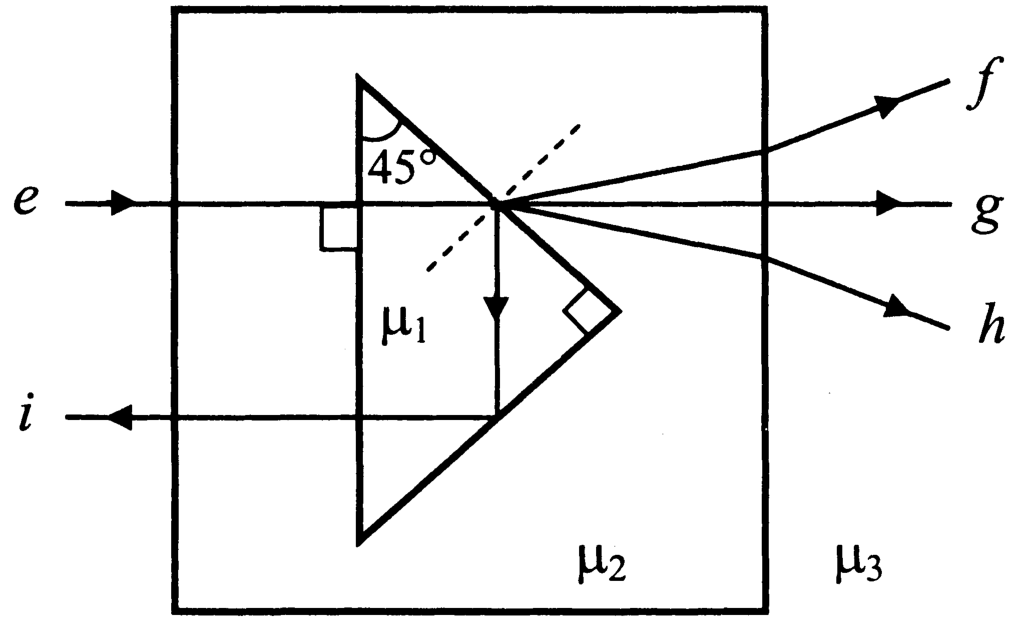
A right-angled prism of refractive index is positioned within a rectangular block of refractive index , which is further surrounded by a medium of refractive index , as depicted in the figure. A light ray '' enters the rectangular block at normal incidence. Depending on the relationships among , , and , the ray takes one of the four possible paths '', '', '', or ''.
Match the paths in List I with the conditions of refractive indices in List II and select the correct answer using the codes given below the lists:
Options
P 2, Q 3, R 1, S 4
P 1, Q 2, R 4, S 3
P 4, Q 1, R 2, S 3
P 2, Q 3, R 4, S 1
Topics & Concepts
Step-by-Step Solution
To determine the relationship between the paths taken by the light ray and the refractive indices of the media, let us analyze the refraction and reflection at each interface:
-
Path (Total Internal Reflection):
- The ray of light inside the prism () strikes the first slanted face at an angle of incidence .
- For total internal reflection (TIR) to occur at this interface into medium , the condition is:
- After undergoing TIR at the upper inclined face, the ray travels vertically downwards and undergoes a second TIR at the lower inclined face, emerging horizontally in the reverse direction along path .
- Hence, .
-
Path (Undeviated Ray):
- If , there is no change in refractive index at the prism-block interface.
- The ray passes through the prism without any deviation and subsequently exits the rectangular block at normal incidence into medium , continuing undeviated along path .
- Hence, .
-
Path (Ray Deviating Upwards):
- If , the ray moves from an optically rarer medium () to a denser medium () at the inclined interface.
- The ray bends towards the normal (which is directed upwards and to the right), deflecting upwards.
- At the exit vertical face of the rectangular block, the ray travels from a denser medium () to a rarer medium () since , thereby bending away from the horizontal normal (further upwards) along path .
- Hence, .
-
Path (Ray Deviating Downwards):
- If , the ray moves from an optically denser medium () to a rarer medium (), but the angle of incidence () is less than the critical angle .
- Therefore, refraction occurs, and the ray bends away from the normal (deflecting downwards).
- At the exit vertical face of the rectangular block, since , the ray bends away from the horizontal normal (further downwards) along path .
- Hence, .
Matching the lists:
Therefore, the correct option is D.