Refraction and Lateral Displacement in Variable Index Slab
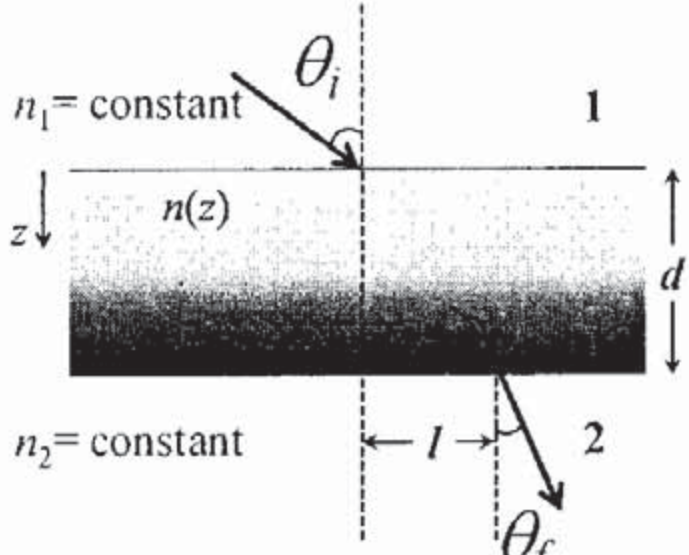
A transparent slab with thickness possesses a refractive index which increases along , where represents the vertical depth within the slab measured from its top surface. The slab is situated between two media of constant refractive indices and , as depicted in the figure. A light ray enters from medium 1 at an angle of incidence and exits into medium 2 at a refraction angle , undergoing a lateral shift .
Which of the following statement(s) is(are) true?
Options
is independent of
is dependent on
Topics & Concepts
Step-by-Step Solution
To determine the correct statements, we analyze the refraction of light through a continuously varying medium stratified in parallel layers along the -axis.
1. Application of Snell's Law
For a medium whose refractive index varies only along the depth (parallel planar layers), Snell's law holds across all infinitesimally thin parallel layers:
At the top boundary, as the light enters from medium 1 into the slab at depth :
At any arbitrary depth within the slab:
At the bottom interface (), as the light exits the slab into medium 2:
By equating the conserved quantity throughout the path:
Thus, Statement (A) is TRUE and Statement (B) is FALSE.
2. Derivation of Lateral Shift
The lateral shift is the total horizontal distance traversed by the ray as it travels through the slab from depth to .
For an infinitesimal vertical displacement , the corresponding horizontal displacement is given by:
From Snell's law, we have:
Using the trigonometric identity :
Integrating from to , the total lateral shift is:
From this expression:
- The lateral shift depends directly on the function within the slab. Thus, Statement (D) is TRUE.
- The lateral shift depends only on , , , and , and is completely independent of the refractive index of the medium below the slab. Thus, Statement (C) is TRUE.
Conclusion
The correct options are A, C, and D.