Reactivity Order of Aromatic Amines Towards Coupling Reaction
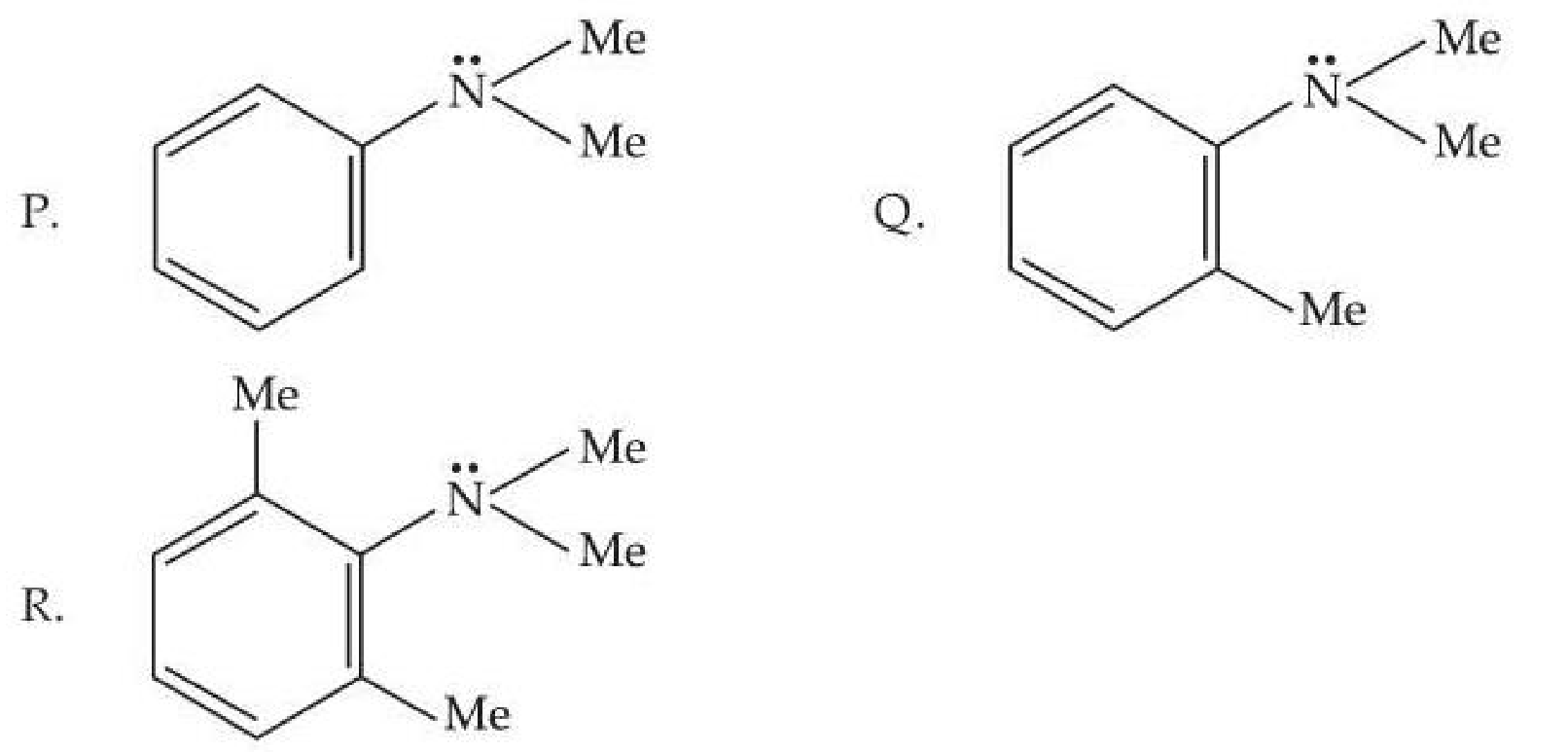
Consider the three aromatic molecules (P, Q and R) whose structures have been given below :
The correct order regarding the reactivity of these compounds with under optimum but slightly acidic medium is :
Options
Topics & Concepts
Step-by-Step Solution
To determine the reactivity order of the given aromatic amines towards the diazo-coupling reaction with benzenediazonium chloride (), we analyze the mechanism of the reaction and the electronic effects operating in each molecule:
-
Reaction Mechanism: The coupling reaction of a diazonium cation with an aromatic amine is an Electrophilic Aromatic Substitution (). Because the phenyldiazonium ion () is a relatively weak electrophile, the reaction requires a strongly activated benzene ring. The presence of a strongly activating group like increases electron density in the aromatic ring via resonance ( effect), facilitating the electrophilic attack.
-
Steric Inhibition of Resonance (SIR) Effect:
-
Compound P (-dimethylaniline): There are no steric substituents at the ortho-positions. The group lies co-planar with the benzene ring, allowing maximum overlap between the unshared electron pair on nitrogen and the -system of the ring ( effect). Consequently, the aromatic ring is strongly activated, making P the most reactive towards coupling.
-
Compound Q (-trimethylaniline): The presence of one methyl group at the ortho-position creates steric crowding with the bulky group. To relieve steric strain, the group rotates out of the plane of the benzene ring to some extent. This partial Steric Inhibition of Resonance (SIR) reduces the effective conjugation ( effect) of the nitrogen lone pair with the ring, leading to lower reactivity compared to P.
-
Compound R (-tetramethylaniline): The presence of two methyl groups at both ortho-positions causes extreme steric hindrance, forcing the group completely out of the plane of the aromatic ring. This severe SIR effect nearly eliminates the resonance () donation of the nitrogen lone pair into the ring. As a result, the benzene ring is the least activated among the three, making R the least reactive towards diazo-coupling.
-
-
Conclusion: Comparing the degree of activation of the aromatic ring due to the SIR effect:
Thus, the correct option is A.