Reactions of Substituted Benzenoid Derivatives to Form Products P Q R S
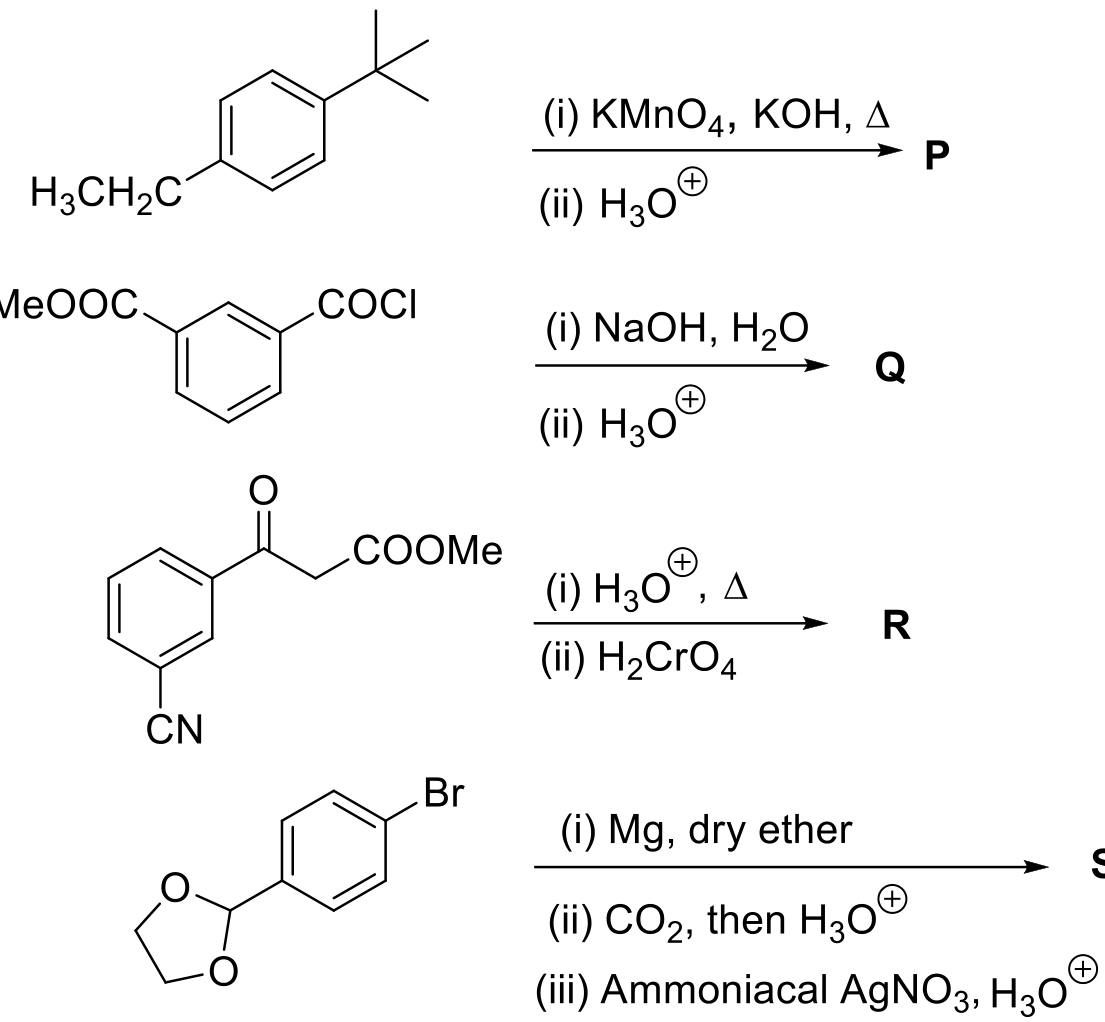
In the following reactions, P, Q, R, and S are the major products.
The correct statement(s) about P, Q, R, and S is(are)
Options
A
P and Q are monomers of polymers dacron and glyptal, respectively.
B
P, Q, and R are dicarboxylic acids.
CCorrect
Compounds Q and R are the same.
DCorrect
R does not undergo aldol condensation and S does not undergo Cannizzaro reaction.
Step-by-Step Solution
To determine the correct statement(s), let us analyze the step-by-step chemical transformations to identify the major products P, Q, R, and S.
1. Formation of Product P
- Reactant: 1-ethyl-4-tert-butylbenzene.
- Reagents:
- Mechanism:
- The ethyl group () has benzylic hydrogens (-hydrogens) and is vigorously oxidized by alkaline upon heating to form a carboxylate group (), which gives a carboxylic acid group () after acidic workup.
- The tert-butyl group () lacks benzylic hydrogens and therefore remains unreacted during oxidation.
- Product P: 4-tert-butylbenzoic acid (a monocarboxylic acid).
2. Formation of Product Q
- Reactant: Methyl 3-(chlorocarbonyl)benzoate (a 1,3-disubstituted benzene containing and ).
- Reagents:
- Mechanism:
- Base-catalyzed hydrolysis converts both the acid chloride () and the methyl ester () groups into carboxylate anions ().
- Acidification with protonates these groups to yield dicarboxylic acid.
- Product Q: Benzene-1,3-dicarboxylic acid (isophthalic acid).
3. Formation of Product R
- Reactant: 3-(3-methoxy-3-oxopropanoyl)benzonitrile (a 1,3-disubstituted benzene containing and ).
- Reagents:
- Mechanism:
- Step (i): Acidic hydrolysis converts the nitrile group () into a carboxylic acid group () and the methyl ester () into a carboxylic acid group (), forming .
- Upon heating (), the resulting -keto acid moiety undergoes decarboxylation to release , yielding 3-acetylbenzoic acid ().
- Step (ii): Treatment with chromic acid () oxidizes the acetyl group () to a carboxylic acid group ().
- Product R: Benzene-1,3-dicarboxylic acid (isophthalic acid).
4. Formation of Product S
- Reactant: 2-(4-bromophenyl)-1,3-dioxolane.
- Reagents:
- , dry ether
- , then
- Ammoniacal ,
- Mechanism:
- Step (i): Reaction with in dry ether forms the Grignard reagent at the aryl bromide position ().
- Step (ii): Nucleophilic addition of the Grignard reagent to followed by acidic workup introduces a carboxylic acid group () at the 4-position. Concurrently, the acidic conditions deprotect the 1,3-dioxolane acetal group back to an aldehyde group (), forming 4-formylbenzoic acid.
- Step (iii): Ammoniacal (Tollens' reagent) selectively oxidizes the aldehyde group () to a carboxylate anion, which upon acidification yields a carboxylic acid group ().
- Product S: Benzene-1,4-dicarboxylic acid (terephthalic acid).
Evaluation of Options:
-
(A) Incorrect:
- The monomer of Dacron is terephthalic acid (benzene-1,4-dicarboxylic acid), whereas P is 4-tert-butylbenzoic acid.
- The monomer of Glyptal is phthalic acid (benzene-1,2-dicarboxylic acid), whereas Q is isophthalic acid (benzene-1,3-dicarboxylic acid).
-
(B) Incorrect:
- P is a monocarboxylic acid (4-tert-butylbenzoic acid), not a dicarboxylic acid.
-
(C) Correct:
- Both Q and R are benzene-1,3-dicarboxylic acid (isophthalic acid).
-
(D) Correct:
- R is a dicarboxylic acid and does not contain carbonyl compounds with -hydrogens, so it does not undergo aldol condensation.
- S is a dicarboxylic acid (terephthalic acid) and is not an aldehyde, so it does not undergo the Cannizzaro reaction.
Conclusion:
The correct statements are C and D.