Reaction Sequence of Minor Product from Aniline Nitration
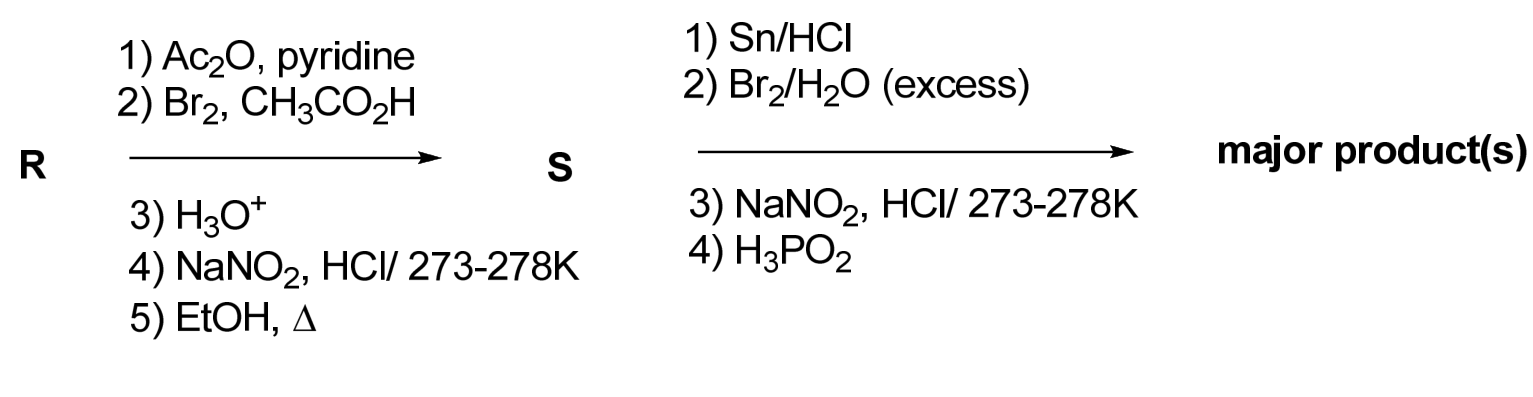
Aniline is treated with a mixture of conc. HNO3 and conc. H2SO4 at 288 K, yielding products P (51%), Q (47%), and R (2%). Determine the major product(s) formed in the reaction sequence starting from R as shown below:
To determine the major product(s) of the given reaction sequence, let us analyze the steps systematically:
Step 1: Identification of Compound R
The nitration of aniline using mixed acid (conc. HNO3+conc. H2SO4) at 288 K yields three isomers:
p-nitroaniline (51%) →P
m-nitroaniline (47%) →Q
o-nitroaniline (2%) →R
Thus, compound R is o-nitroaniline (2-nitroaniline).
Step 2: Conversion of R to S
Protection of −NH2 group:o-nitroanilineAc2O, pyridineo-nitroacetanilide
Bromination:o-nitroacetanilideBr2,CH3COOH4-bromo-2-nitroacetanilide
The strongly activating −NHCOCH3 group directs the incoming bromine to its para-position (C-4).
Deamination:4-bromo-2-nitrobenzenediazonium chlorideEtOH, Δ1-bromo-3-nitrobenzene (S)
Thus, compound S is 1-bromo-3-nitrobenzene (m-bromonitrobenzene).
Step 3: Conversion of S to the Final Product
Reduction of −NO2 group:1-bromo-3-nitrobenzene (S)Sn/HCl3-bromoaniline
Poly-bromination:3-bromoanilineBr2/H2O (excess)2,3,4,6-tetrabromoaniline
The −NH2 group at position 1 is strongly activating and directs bromine to all open ortho and para positions (C-2, C-4, and C-6), while C-3 already contains a bromine atom.
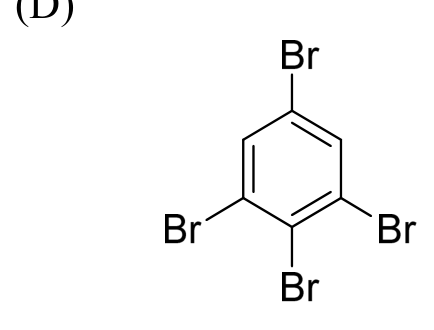
Deamination:2,3,4,6-tetrabromobenzenediazonium chlorideH3PO21,2,3,5-tetrabromobenzene
The −N2+ group at position 1 is replaced by hydrogen (−H), leaving bromine atoms at positions 1,2,3, and 5 relative to the ring IUPAC numbering.
Conclusion
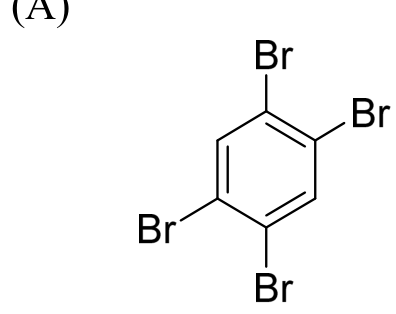
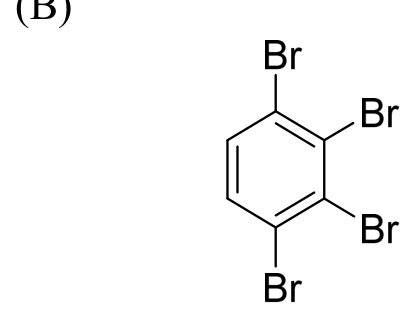
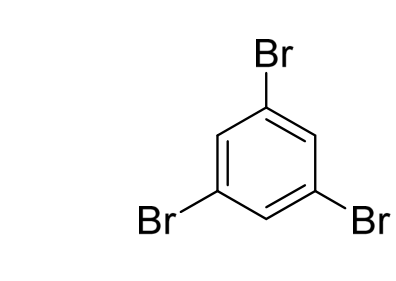
Comparing the structure of 1,2,3,5-tetrabromobenzene with the given options: