Reaction Sequence Involving Lactone Reduction and Oxidation Reactions
For the reaction sequence given below, the correct statement(s) is(are)
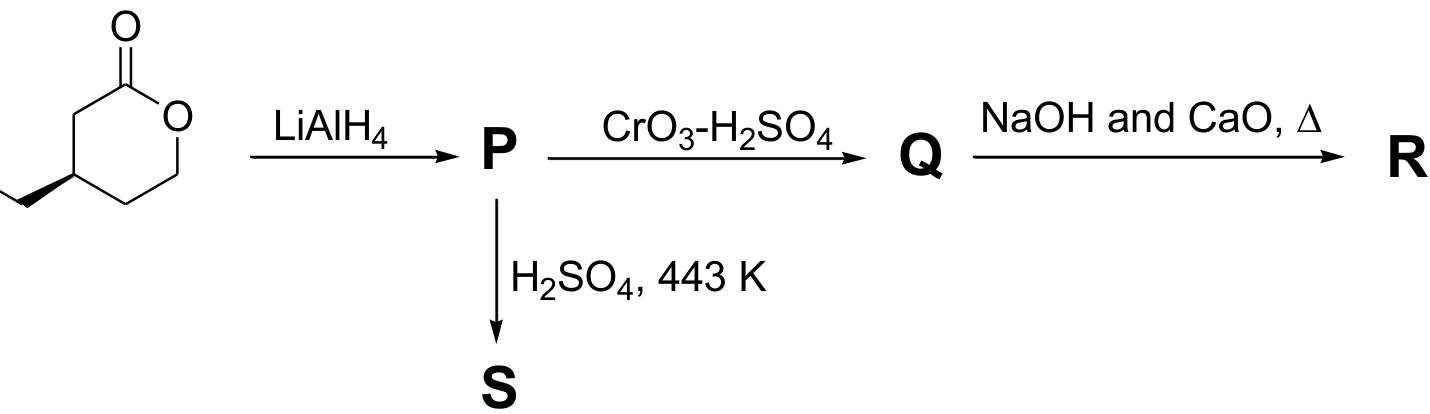
Options
is optically active.
gives Bayer's test.
gives effervescence with aq. .
is an alkyne.
Step-by-Step Solution
To determine the correct statements, we analyze each step of the given reaction sequence:
1. Identification of Compound
The starting material is a -membered cyclic lactone (-benzyltetrahydro--pyran--one).
Reduction of this lactone using lithium aluminium hydride () cleaves the ester linkage to yield a primary diol, 3-benzylpentane-1,5-diol ():
-
Symmetry and Optical Activity: The C-3 carbon of is bonded to:
- A hydrogen atom ()
- A benzyl group ()
- Two identical -hydroxyethyl groups ()
Since two identical substituents are attached to the central C-3 atom, the molecule possesses a plane of symmetry (). Consequently, is achiral and optically inactive.
Option A is incorrect.
2. Identification of Compound
Oxidation of diol using Jones reagent () oxidizes both primary alcohol groups () to carboxylic acid groups ():
-
Reaction with : Compound is a dicarboxylic acid (-benzylpentanedioic acid). Carboxylic acids react with aqueous sodium bicarbonate () to evolve carbon dioxide gas (), producing brisk effervescence:
Option C is correct.
3. Identification of Compound
Heating dicarboxylic acid with soda lime ( and ) results in complete decarboxylation, removing both carboxylic acid groups as :
-
Nature of Compound : Compound is isobutylbenzene, which is an substituted aromatic alkane, not an alkyne.
Option D is incorrect.
4. Identification of Compound
Heating diol with concentrated at () undergoes acid-catalyzed double dehydration (elimination) to yield an unsaturated compound containing carbon-carbon double bonds (), such as 3-benzylpenta-1,4-diene:
-
Baeyer's Test: Alkenes/dienes contain double bonds and react with cold, dilute, alkaline solution (Baeyer's reagent) to form glycol derivatives with the decolorization of the purple solution. Thus, gives a positive Baeyer's test.
Option B is correct.
Conclusion:
The correct statements are B and C.