Reaction Sequence Involving Kolbe Electrolysis and Phthalic Anhydride Derivatives
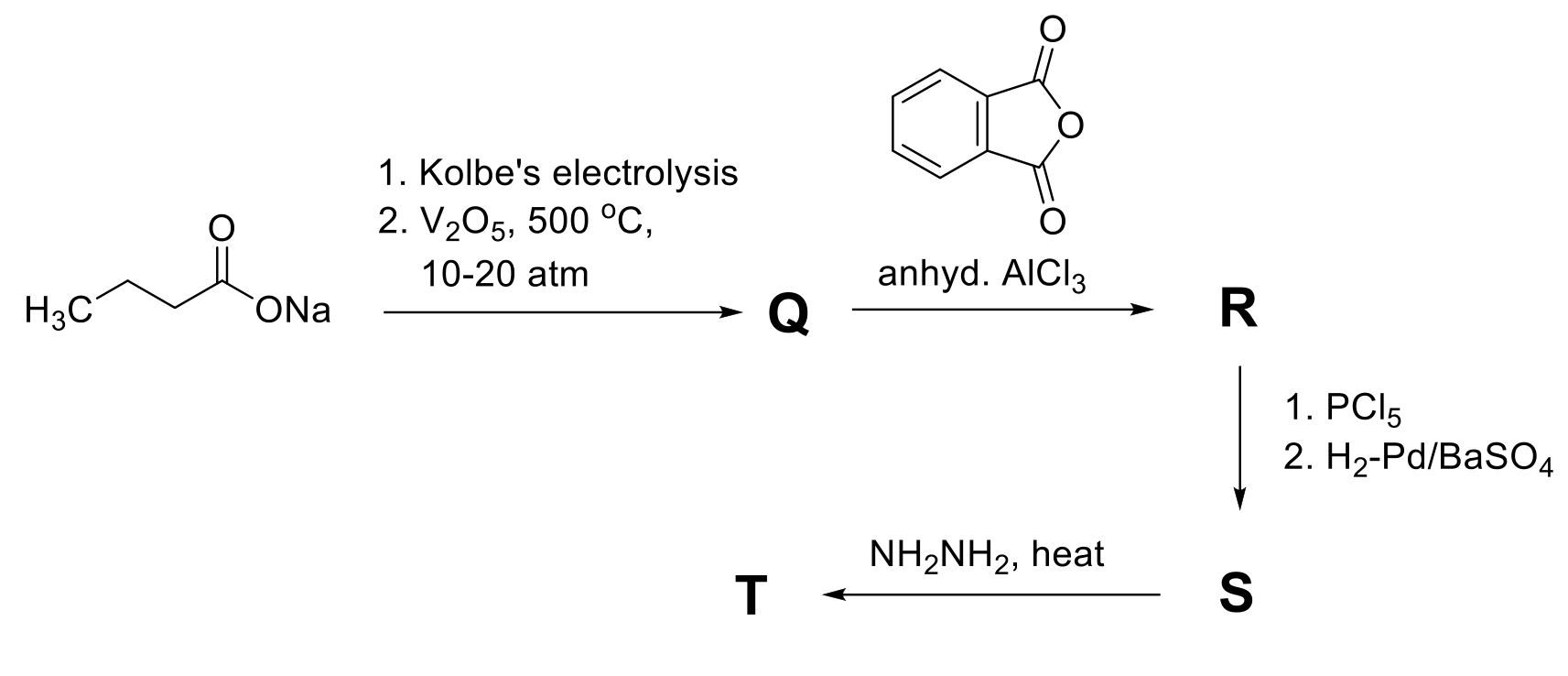
In the following reaction sequence, , , and are the major products.
The correct statement(s) about , , and is(are)
Options
on warming with ammoniacal results in the formation of silver mirror.
on treatment with gives gammaxane.
is a heterocyclic compound.
on acid catalyzed intramolecular cyclization followed by treatment with gives 9,10-dihydroxyanthracene.
Step-by-Step Solution
To determine the correct statements, let us analyze the given reaction sequence step-by-step:
Step 1: Identification of Compound Q
-
Kolbe's Electrolysis: The starting reactant is sodium butyrate, . Electrolysis of this sodium carboxylate salt results in decarboxylative dimerization:
-
Aromatization: Heating -hexane with vanadium pentoxide () at and causes catalytic dehydrocyclization (reforming) to yield benzene:
- Evaluation of Option (B): Benzene () on treatment with excess under UV light undergoes free-radical addition to give benzene hexachloride ( or BHC). The -isomer of BHC is commonly known as gammaxane (lindane). Therefore, Statement (B) is correct.
Step 2: Identification of Compound R
Benzene () reacts with phthalic anhydride in the presence of anhydrous via a Friedel-Crafts acylation reaction: Thus, is 2-benzoylbenzoic acid.
Step 3: Identification of Compound S
- Reaction of (2-benzoylbenzoic acid) with converts the carboxylic acid group () into an acyl chloride group (), forming .
- Subsequent treatment with (Rosenmund reduction) selectively reduces the acyl chloride group () to an aldehyde group (): Thus, is 2-benzoylbenzaldehyde.
- Evaluation of Option (A): Since contains an aldehyde group (), warming it with ammoniacal (Tollen's reagent) reduces the ions to metallic silver, forming a silver mirror. Therefore, Statement (A) is correct.
Step 4: Identification of Compound T
Reaction of () with hydrazine () upon heating results in condensation with both carbonyl groups (the aldehyde and the ketone) to form a fused six-membered ring containing two adjacent nitrogen atoms:
- Evaluation of Option (C): 1-phenylphthalazine () contains a bicyclic aromatic system with nitrogen atoms present in the ring structure. Hence, it is a heterocyclic compound. Therefore, Statement (C) is correct.
Step 5: Evaluation of Option (D)
- Acid-catalyzed intramolecular cyclization of 2-benzoylbenzoic acid () using concentrated yields 9,10-anthraquinone.
- Subsequent treatment of 9,10-anthraquinone with (Clemmensen reduction) reduces both carbonyl groups () completely to methylene groups (), giving anthracene, not 9,10-dihydroxyanthracene. Therefore, Statement (D) is incorrect.
Conclusion:
The correct statements are A, B, and C.