Reactant Concentration Variation with Time for Three Reactions
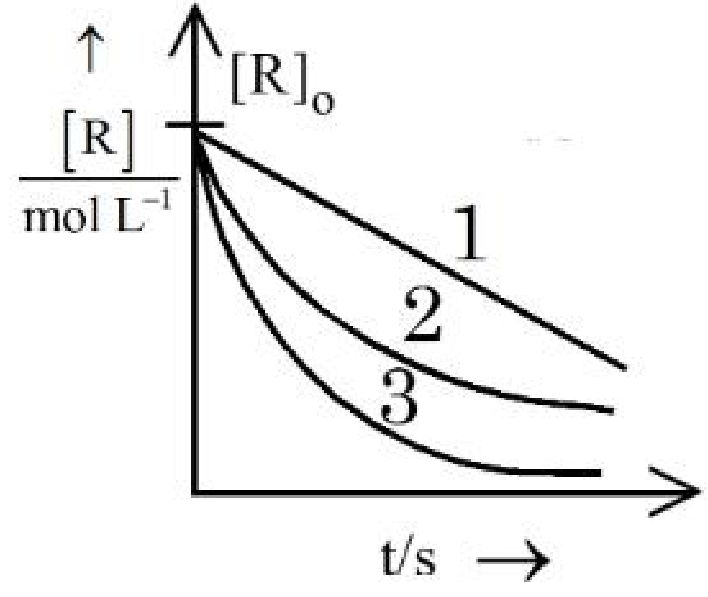
Consider the given graph showing variation of reactant concentration with time.
Three different reactions were started with identical initial concentration of reactants. Which of the following statement is correct?
Options
A
The order of all the three reactions is same.
BCorrect
The rate constant of reaction 3 is larger than the rate constant of reaction 2 if the order of reaction is same for both.
C
The SI unit of rate constant of reaction 1 is .
D
Thermal decomposition of on gold surface is an example of reaction 2.
Topics & Concepts
Step-by-Step Solution
To determine the correct statement, let us analyze the given concentration-time ( vs ) graph for the three reactions starting from the same initial concentration :
-
Analysis of Curve 1:
- Curve 1 is a straight line with a negative slope. This corresponds to a zero-order reaction, for which the rate law is given by:
- For a zero-order reaction, the unit of the rate constant is:
- Therefore, Option C is incorrect because is the SI unit for a first-order rate constant, not zero-order.
- Thermal decomposition of on a gold surface is a classic example of a zero-order reaction, which is represented by curve 1, not curve 2. Thus, Option D is incorrect.
-
Analysis of Curves 2 and 3:
- For a reaction of order , the general rate equation is:
- Integrating this equation for gives:
- For (), integration gives:
- In both cases, for a fixed order and identical initial concentration , a larger rate constant causes the reactant concentration to decrease more rapidly over time .
- Looking at the graph, at any given time :
- This shows that the concentration of reactant decreases faster in reaction 3 than in reaction 2. Thus, if both reactions have the same order, the rate constant of reaction 3 must be larger than that of reaction 2 ().
- Therefore, Option B is correct.
-
Evaluation of Option A:
- Reaction 1 is linear (zero-order) while reactions 2 and 3 are non-linear curves. Hence, all three reactions do not have the same order, making Option A incorrect.
Correct Answer: B