Ratio of Thermal Conductivities in Series Cylinders
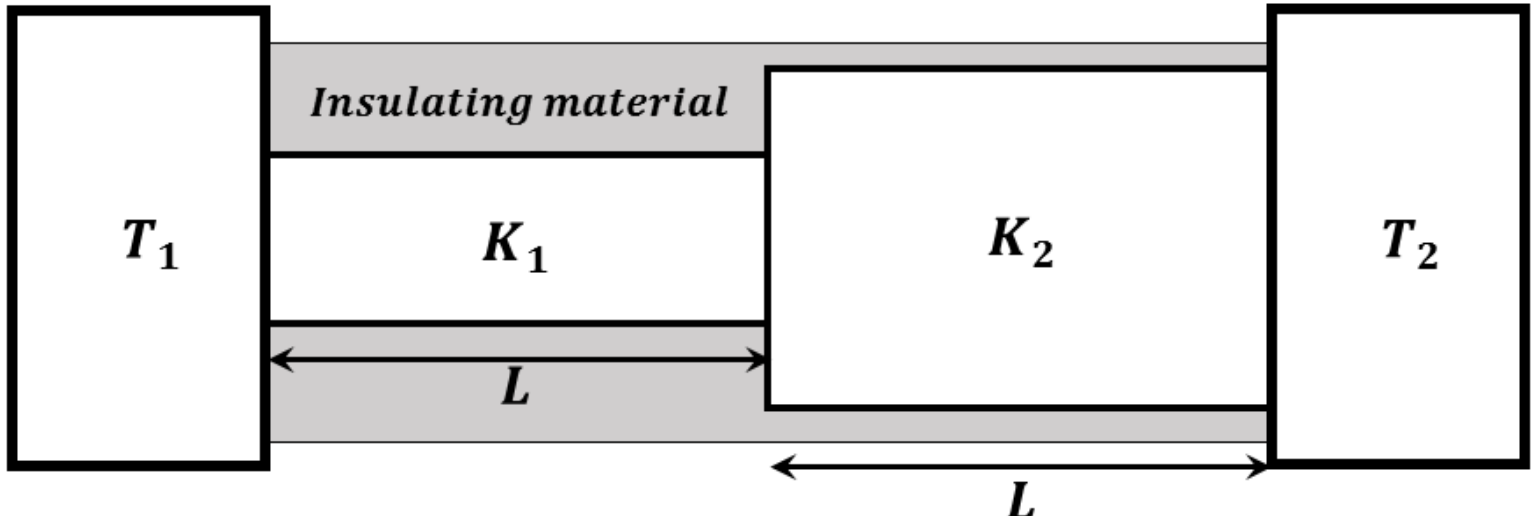
Two conducting cylinders having identical lengths but different radii are connected in series between two thermal reservoirs maintained at temperatures and , as depicted in the figure. The radius of the larger cylinder is twice that of the smaller one, and the thermal conductivities of the materials of the smaller and larger cylinders are and , respectively. If the junction temperature between the two cylinders in the steady state is , calculate the ratio _______.
Topics & Concepts
Step-by-Step Solution
To find the ratio of the thermal conductivities , we consider the steady-state heat conduction through the two cylinders connected in series.
Let:
- be the length of each cylinder.
- be the radius of the smaller cylinder, so its cross-sectional area is .
- be the radius of the larger cylinder, so its cross-sectional area is:
- be the temperature of the heat bath connected to the smaller cylinder.
- be the temperature of the heat bath connected to the larger cylinder.
- be the steady-state temperature at the junction.
Since the sides are thermally insulated, there is no lateral heat loss. In the steady state, the rate of heat flow through the smaller cylinder must equal the rate of heat flow through the larger cylinder:
Using Fourier's law of thermal conduction:
Substitute the given temperatures:
Thus, the equation simplifies to:
Now, substituting :
Dividing both sides by :