Ratio of Magnetic Fields at Centre of Semicircular Arcs
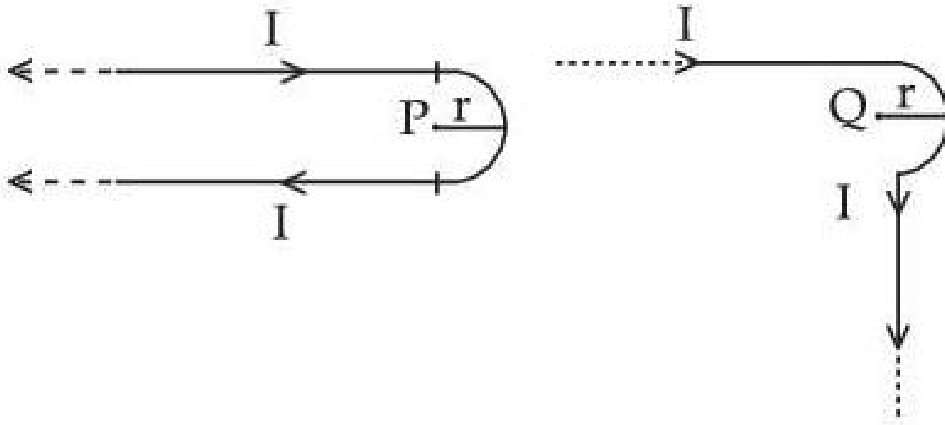
Two identical long current carrying wires are bent into the shapes shown in the following figures. If the magnitude of magnetic fields at the centres P and Q of a semicircular arc are and respectively, then the ratio is _______.
Options
Topics & Concepts
Step-by-Step Solution
To find the ratio of the magnitudes of the magnetic fields and at the centers and of the semicircular arcs, we analyze the contribution of each segment of the wires using the Biot-Savart law.
1. Calculation of Magnetic Field at Point (Figure I)
Figure (I) consists of three current-carrying segments:
-
Top semi-infinite horizontal wire: Extends from to at a distance above point . Current flows in the direction. The magnetic field at due to this semi-infinite wire is:
-
Semicircular arc: Has a radius and carries current in a clockwise direction. The magnetic field at the center due to the semicircular arc is:
-
Bottom semi-infinite horizontal wire: Extends from to at a distance below point . Current flows in the direction. The magnetic field at due to this semi-infinite wire is:
Since all three magnetic field components point into the page (), they add up algebraically:
2. Calculation of Magnetic Field at Point (Figure II)
Figure (II) also consists of three current-carrying segments:
-
Top semi-infinite horizontal wire: Identical to the top wire in Figure (I). Its magnetic field contribution at is:
-
Semicircular arc: Identical to the semicircular arc in Figure (I). Its magnetic field contribution at is:
-
Vertical semi-infinite wire: Extends vertically downwards from the end of the semicircular arc along the line passing through point . Since the line along which this wire lies passes directly through point , the angle between the current element vector and the position vector is (). Thus, its contribution to the magnetic field at is zero:
Summing the non-zero magnetic field contributions at :
3. Ratio of the Magnetic Fields
Dividing by :
Thus, the correct option is A.