Qualitative Sketch of Radial Probability Distribution for Hydrogen Atom 1s Electron
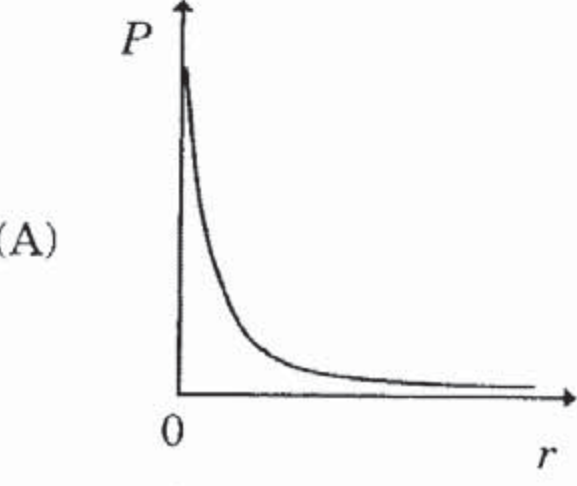
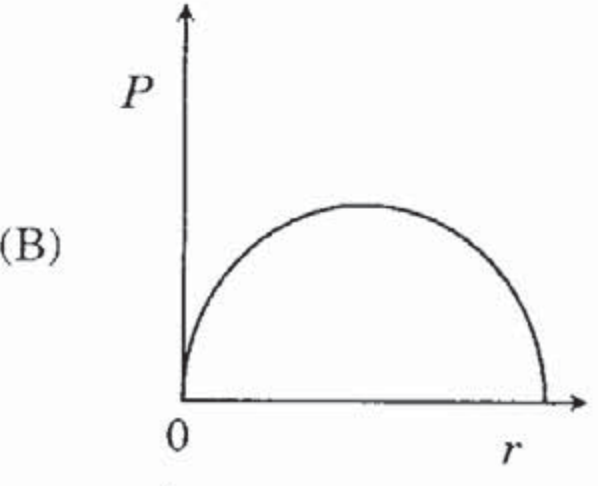
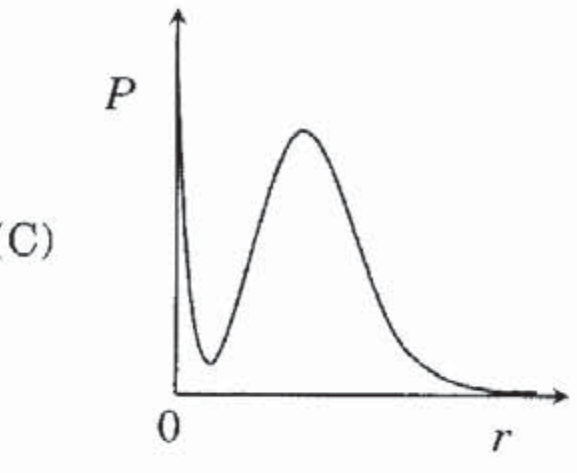
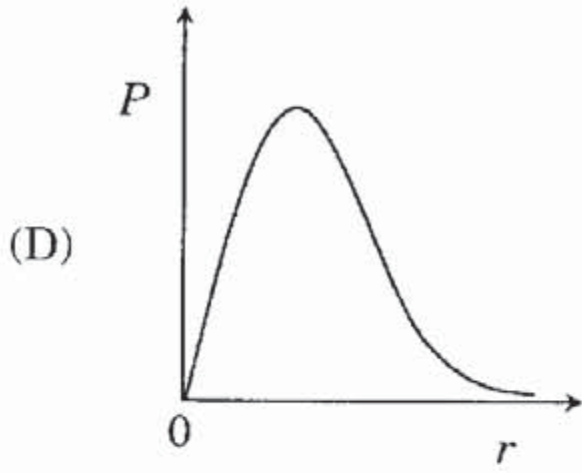
Let represent the probability of discovering the 1s electron of a hydrogen atom within a thin spherical shell of infinitesimal thickness located at a distance from its nucleus. Given that the volume of this shell equals , select the qualitative plot illustrating the variation of with respect to .
Options
Topics & Concepts
Step-by-Step Solution
To find the qualitative plot illustrating the variation of radial probability with respect to distance from the nucleus for a 1s electron in a hydrogen atom, we use quantum mechanics principles:
-
Wavefunction of electron: The normalized radial wavefunction for the electron of a hydrogen atom is given by: where is the Bohr radius.
-
Probability of finding the electron: The probability of finding the electron within a thin spherical shell of thickness at a distance from the nucleus is the product of the probability density and the volume of the shell :
- Analyzing the function :
-
At : This indicates that the probability of finding the electron in a shell of radius zero is zero.
-
As : The probability decreases asymptotically towards zero as becomes very large due to the exponential decay factor .
-
Maximum Probability (Most probable radius): To find the value of where reaches its maximum, we set the derivative of the radial probability density with respect to to zero:
Solving for : Thus, the radial probability reaches a single maximum peak at (the Bohr radius).
- Conclusion:
- The graph must start at the origin .
- It rises to a single maximum peak at .
- It decays exponentially and approaches zero asymptotically as without touching the horizontal axis at any finite distance .
This behavior is correctly represented in plot (D).
Correct Option: D