Proportionality of Induced Current in Zero Resistance Loop
A special metallic material conducts electricity with zero resistance. A closed loop made of maintains constant flux by inducing an appropriate current to produce a compensating magnetic flux. This induced current persists without decay owing to zero resistance. This current creates a magnetic moment that repels the magnetic field source. Suppose a loop of radius has its center at the origin. A magnetic dipole with moment is moved along the loop's axis from infinity to a distance () from the center, keeping its north pole towards the loop, as depicted below.
The magnetic field magnitude of a dipole at a distance along its axis is given by , where represents the free space permeability. The force magnitude between two axial magnetic dipoles and separated by distance with like poles facing is , with being a constant of suitable dimensions. This force acts along the axis joining both dipoles.
When the dipole is situated at a distance from the loop's center, the induced current in the loop is proportional to
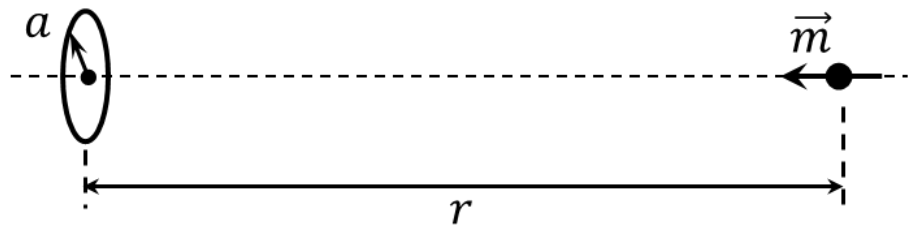
Options
Topics & Concepts
Step-by-Step Solution
To determine how the induced current in the zero-resistance loop depends on the magnetic dipole moment and the axial distance , we apply the principle of conservation of magnetic flux for a superconducting (zero-resistance) circuit.
1. Conservation of Magnetic Flux
Since the loop has zero resistance, any change in external magnetic flux creates an induced current that generates an equal and opposite self-flux to keep the total magnetic flux through the loop constant:
Initially, when the dipole is at infinity (), the flux through the loop is zero. Therefore, at any distance , the total flux must remain zero:
2. External Magnetic Flux ()
The magnetic field along the axis of a magnetic dipole of moment at a distance () is given as:
Since the radius of the loop , the magnetic field across the area of the loop can be considered uniform. Thus, the external magnetic flux through the loop is:
3. Self-Flux () and Induced Current ()
The flux produced by the induced current through the loop is given by: where is the self-inductance of the loop, which depends only on its fixed geometry.
Equating the magnitudes of self-flux and external flux:
Solving for the induced current :
Since , , and are constants:
Thus, the induced current in the loop is proportional to .
Correct Option: (A)