Projectile Motion Passing Through a Specific Point
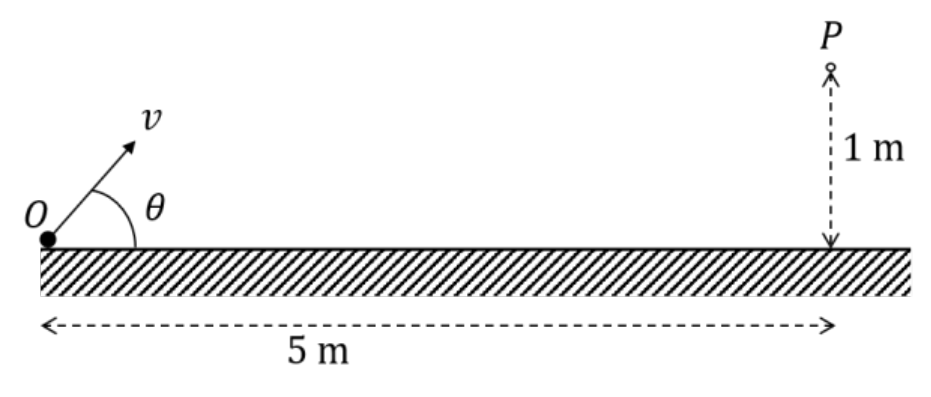
A particle is thrown with a speed v from a point O at an angle θ with the horizontal plane such that it passes through the point P at a height of 1 m and horizontal distance of 5 m from O, as shown in the figure. If acceleration due to gravity is g ms−2, then the correct statement(s) is/are:
Options
A
If θ=45∘, then v=25g ms−1.
Correct
B
If θ=45∘, the particle reaches its maximum height before it reaches P.
Correct
C
If θ=30∘, the particle reaches its maximum height after reaching P.
To determine the correct statement(s), we analyze the equation of the trajectory of the projectile. The trajectory equation in terms of horizontal position x and vertical position y is:
y=xtanθ−2v2cos2θgx2
Given that the particle passes through point P(5,1), we substitute x=5 m and y=1 m:
1=5tanθ−2v2cos2θ25g— (1)
Analysis of Options (A) and (B):
Given θ=45∘, we have tan45∘=1 and cos245∘=21.
Substituting these values into equation (1):
1=5(1)−2v2(21)25g1=5−v225gv225g=4⟹v2=425g⟹v=25g ms−1
Thus, Option (A) is correct.
Next, we calculate the horizontal range R for θ=45∘:
R=gv2sin(2θ)=g(425g)sin(90∘)=425=6.25 m
The maximum height is reached at a horizontal distance:
xmax=2R=26.25=3.125 m
Since xmax=3.125 m<5 m (the x-coordinate of point P), the particle reaches its maximum height before it reaches point P.
Thus, Option (B) is correct.
Analysis of Option (C):
Given θ=30∘, we have tan30∘=31 and cos230∘=43.
Substituting into equation (1):
1=5(31)−2v2(43)25g1=35−3v250g⟹3v250g=35−3v2=3(5−3)503g
The horizontal range R is:
R=gv2sin(60∘)=3(5−3)503⋅23=5−325≈7.65 m
The horizontal distance to reach maximum height is:
xmax=2R≈27.65=3.825 m
Since xmax≈3.825 m<5 m, the particle reaches its maximum height before reaching point P.
Thus, Option (C) is incorrect.
Analysis of Option (D):
Given θ=tan−1(51), we have tanθ=51.
Substituting into equation (1):
1=5(51)−2v2cos2θ25g1=1−2v2cos2θ25g⟹2v2cos2θ25g=0
This equation has no solution for any finite launch speed v. Geometrically, the line connecting O(0,0) and P(5,1) forms an angle of tan−1(1/5) with the horizontal. Due to downward gravitational acceleration, a projectile launched at this angle will always curve below this line and can never pass through point P for any finite speed.
Thus, Option (D) is incorrect.
Conclusion:
The correct options are A and B.
Projectile Motion Passing Through a Specific Point | Physics PYQ Solution - JEE Challenger