Power Variation of Double Convex Lens Immersed in Liquid
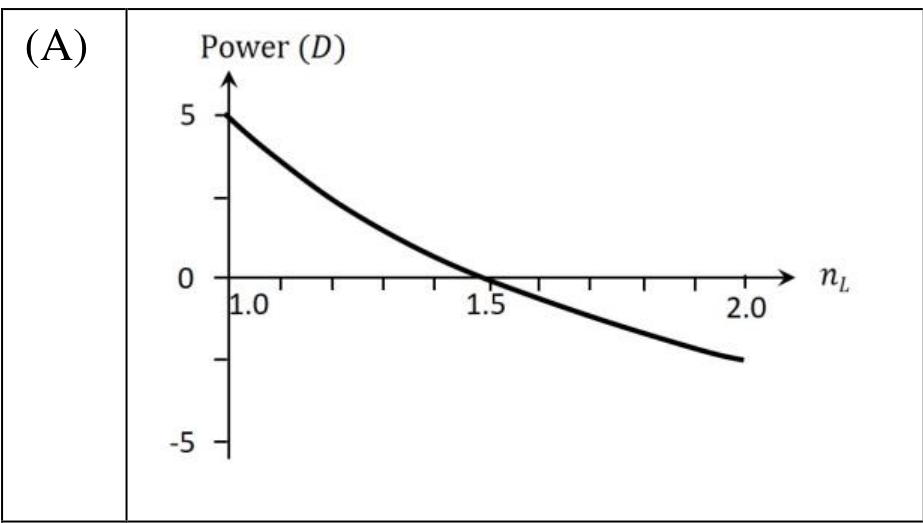
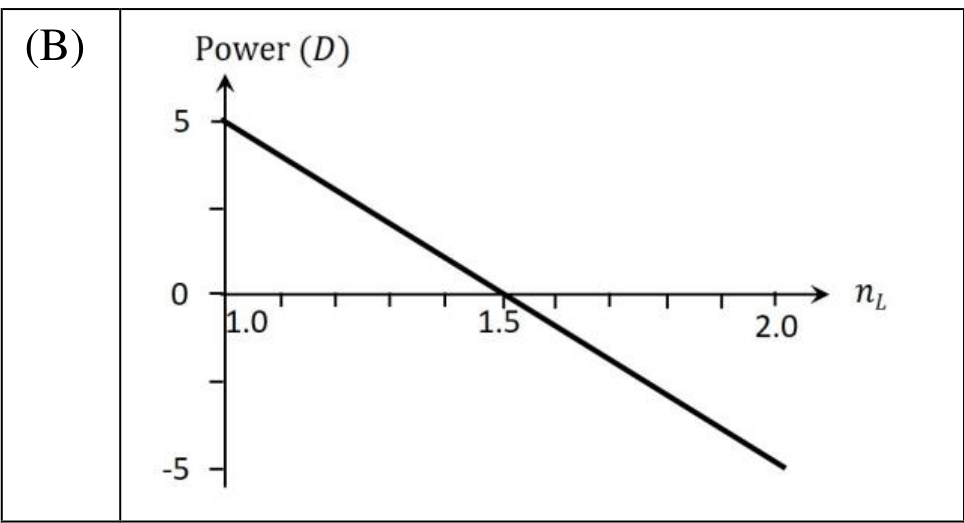
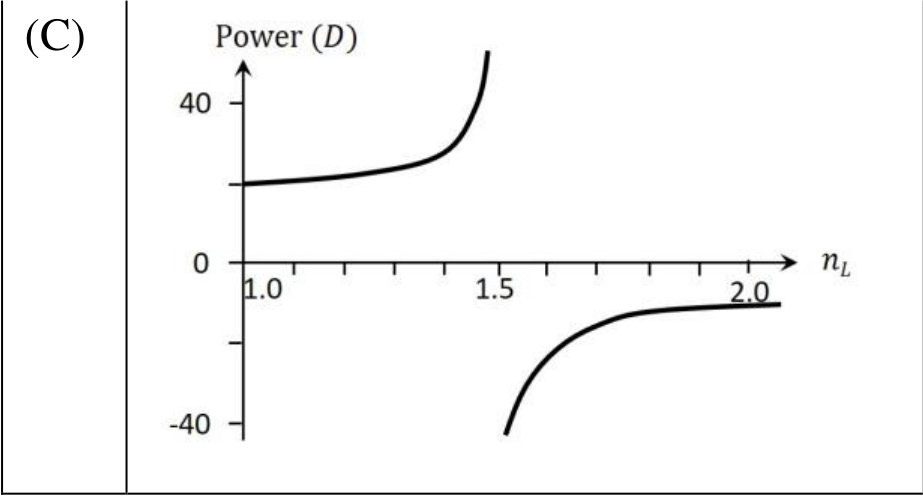
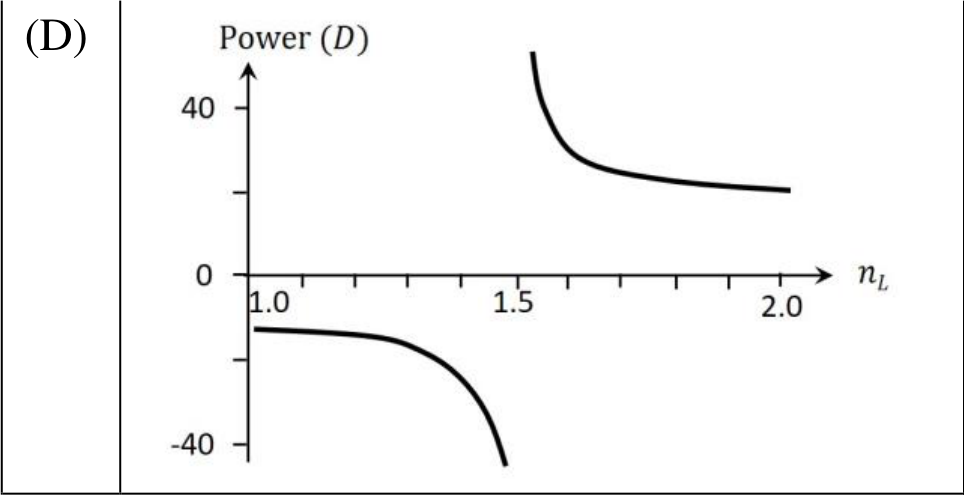
A double convex lens made of glass of refractive index and radii of curvature of the curved surfaces each is immersed in a liquid of refractive index . The correct plot showing the variation of the power, in the units of diopter (), as a function of is:
Options
Step-by-Step Solution
To determine the variation of the power of the double convex lens as a function of the refractive index of the liquid , we use the geometry of the lens and optics principles.
1. Geometric Parameters of the Lens
For a double convex lens:
- Refractive index of the lens,
- Radius of curvature of the first surface,
- Radius of curvature of the second surface,
The curvature factor is calculated as:
2. Definition 1: Power defined as
Using the Lens Maker's Formula for a thin lens immersed in a medium of refractive index :
Substituting the given values, the power in diopters () is:
Evaluating at characteristic values of :
- For :
- For :
- For :
Curve Characteristics:
- First derivative: (monotonically decreasing).
- Second derivative: (convex downwards).
This non-linear hyperbolic relationship corresponds to Option (A).
3. Definition 2: Power defined as the sum of surface refractivity
The optical power of refraction at two spherical boundaries is given by:
Substituting the given values:
Evaluating at characteristic values of :
- For :
- For :
- For :
Curve Characteristics:
- The relationship is linear with a constant negative slope of .
This linear relationship corresponds to Option (B).
Conclusion
Depending on the optical convention used for power of a lens in a medium, both plots (A) and (B) accurately represent the variation.
Correct Options: A or B