Pictorial Diagram of Pi Antibonding Molecular Orbital
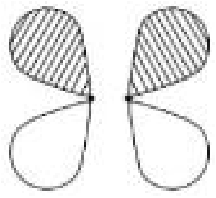
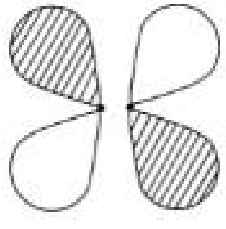
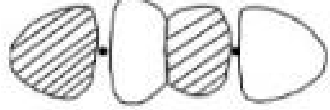
Which of the following pictorial diagram most correctly represents the (-antibonding) molecular orbital between two atoms if the internuclear axis is taken to be in the z-direction ()?
Options

Topics & Concepts
Step-by-Step Solution
To determine the correct pictorial diagram representing the (-antibonding) molecular orbital, we analyze the formation and symmetry of -antibonding orbitals using Molecular Orbital Theory (MOT):
1. Formation of Molecular Orbital
When two parallel atomic orbitals (such as or orbitals) overlap laterally (perpendicular to the internuclear -axis), they combine to form molecular orbitals.
The antibonding molecular orbital () is formed by the out-of-phase combination (destructive interference) of the two atomic orbital wavefunctions:
2. Phase Distribution and Nodal Planes
- Let atomic orbital have a positive phase () in its upper lobe and a negative phase () in its lower lobe.
- Subtracting atomic orbital inverts its phases, resulting in a negative phase () in its upper lobe and a positive phase () in its lower lobe.
Therefore, the phase distribution across the four lobes of the orbital is:
- Upper-left lobe:
- Lower-left lobe:
- Upper-right lobe:
- Lower-right lobe:
This configuration creates two nodal planes (where electron density is zero):
- Horizontal nodal plane: Along the internuclear axis (-axis), separating the upper and lower lobes.
- Vertical nodal plane: Perpendicular to the internuclear axis, passing midway between the two nuclei and separating the left and right lobes.
3. Visual Representation
In orbital diagrams, different phases ( and ) are represented by shaded and unshaded regions, respectively:
- Diagonally opposite lobes share the same phase (both shaded or both unshaded).
- Adjacent lobes have opposite phases (one shaded and one unshaded).
Looking at the options:
- Diagram C correctly shows four lobes with alternating phases: the top-left and bottom-right lobes are shaded, while the top-right and bottom-left lobes are unshaded. It clearly depicts the two perpendicular nodal planes characteristic of a orbital.
Correct Option: C