Phase Space Diagram of Damped Spring Mass System in Water
Paragraph for Question Nos. 35 to 37
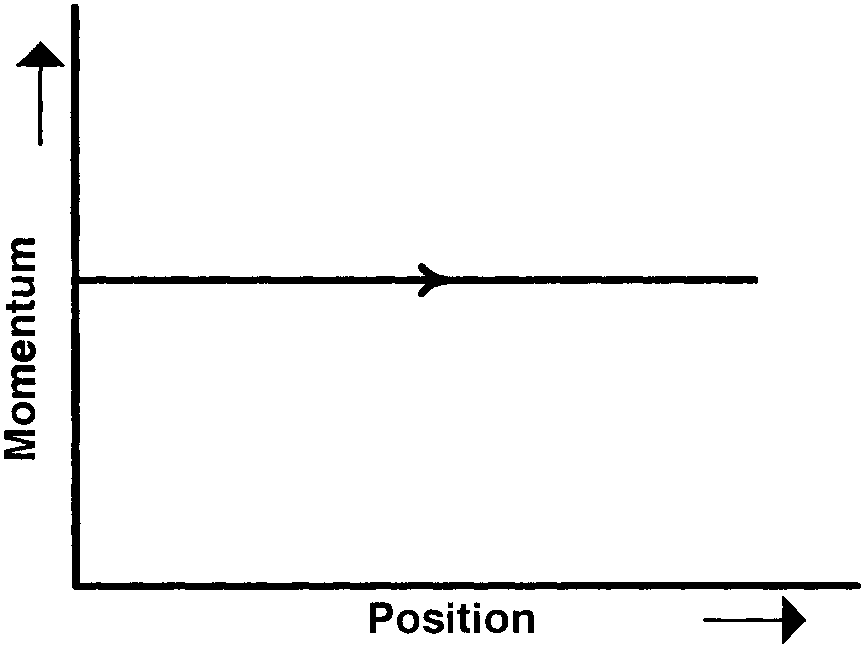
Phase space diagrams are useful tools in analyzing all kinds of dynamical problems. They are especially useful in studying the changes in motion as initial position and momentum are changed. Here we consider some simple dynamical systems in one-dimension. For such systems, phase space is a plane in which position is plotted along horizontal axis and momentum is plotted along vertical axis. The phase space diagram is vs. curve in this plane. The arrow on the curve indicates the time flow. For example, the phase space diagram for a particle moving with constant velocity is a straight line as shown in the figure. We use the sign convention in which position or momentum upwards (or to right) is positive and downwards (or to left) is negative.
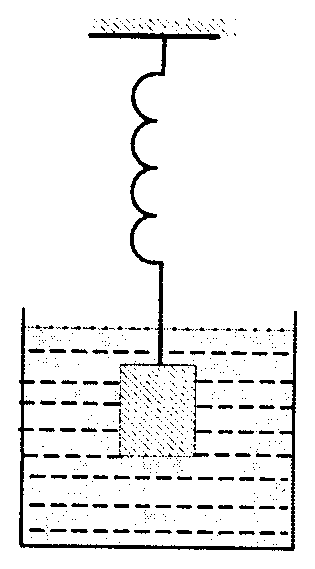
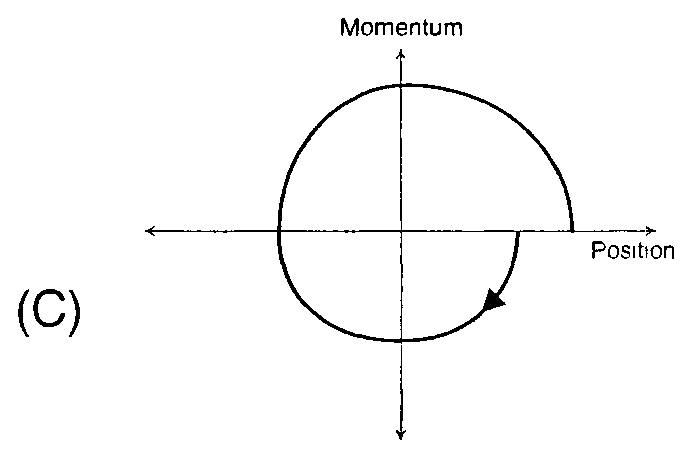
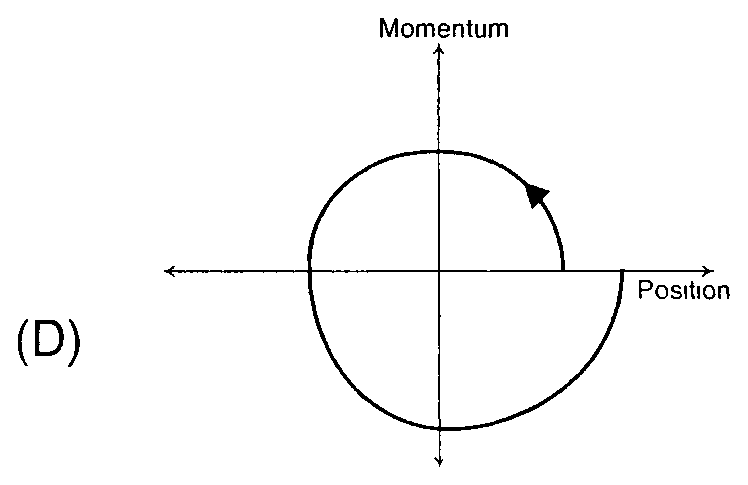
Consider the spring-mass system, with the mass submerged in water, as shown in the figure. The phase space diagram for one cycle of this system is
Options
Topics & Concepts
Step-by-Step Solution
To determine the correct phase space diagram for the damped spring-mass system, we analyze the physical behavior of the system in terms of the phase space variables: position () on the horizontal axis and momentum () on the vertical axis.
1. Trajectory Direction in Phase Space
The velocity (and hence momentum) is related to the rate of change of position:
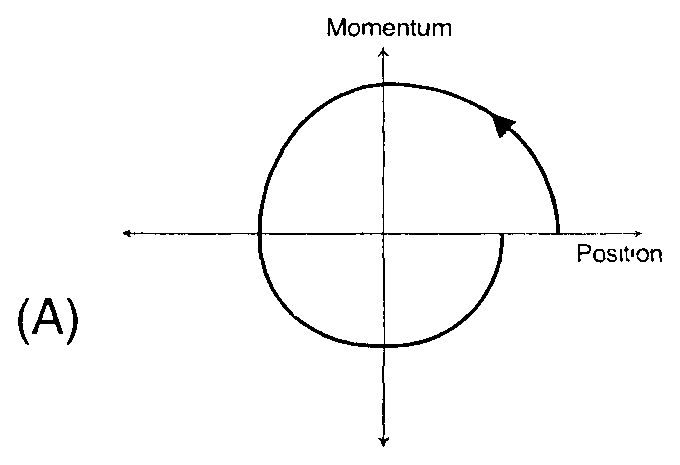
- Upper half-plane (): Since momentum is positive, , meaning the position must increase over time. Therefore, the state point moves from left to right in the upper half-plane.
- Lower half-plane (): Since momentum is negative, , meaning the position must decrease over time. Therefore, the state point moves from right to left in the lower half-plane.
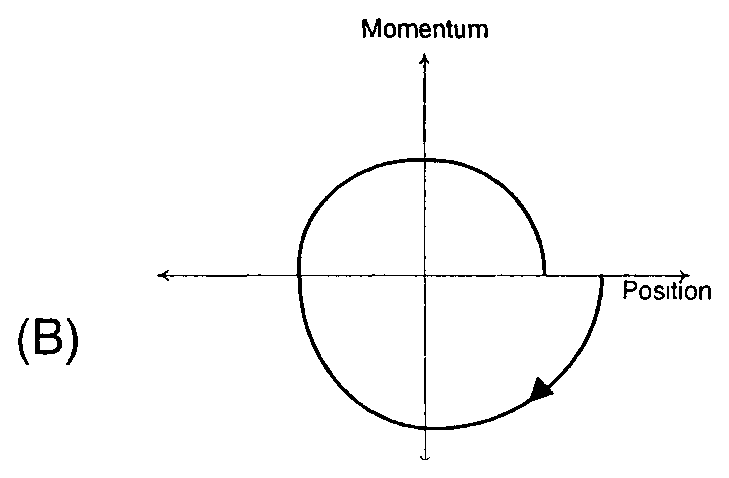
Thus, any physically valid phase space trajectory in the plane must be traversed in a clockwise direction.
2. Effect of Damping (Fluid Resistance)
When the mass is submerged in water, it experiences a viscous drag force (damping force) proportional to its velocity:
Due to this non-conservative damping force, the mechanical energy continuously decreases over time:
As a result, the distance of the phase point from the origin in the plane decreases with time, causing the trajectory to spiral inwards toward the origin. After one complete cycle, the maximum displacement (amplitude) will be strictly less than the initial displacement:
3. Analysis of the Trajectory
Suppose the mass is displaced to a positive position and released from rest ():
- Initial state: on the positive position axis.
- First half-cycle: As the spring pulls the mass back toward equilibrium, the mass moves leftwards ( decreases), so momentum becomes negative (). The curve enters the lower half-plane, moving counter-clockwise around the origin towards negative displacement.
- Second half-cycle: After reaching a negative extreme, the mass moves back toward positive position ( increases), so momentum becomes positive (). The curve enters the upper half-plane, moving rightwards.
- Completion of one cycle: The mass returns to a positive position, but due to energy loss in water, the new position satisfies .
This inner-spiraling, clockwise trajectory corresponds precisely to Option (B).