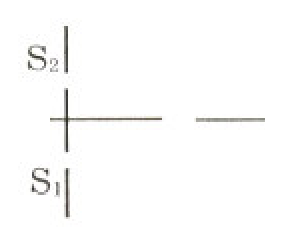
To find the correct matching between Column I and Column II, we determine the net optical path difference Δx and phase difference δ at points P0, P1, and P2 for each case.
The net optical path difference between the waves arriving at any point P on the screen from the two slits is given by:
Δx(P)=(S1P−S2P)−(μ−1)t
where the sheet of thickness t and refractive index μ is introduced in front of slit S2.
The corresponding phase difference is:
δ(P)=λ2π∣Δx(P)∣
and the resulting intensity is:
I(P)=Imaxcos2(2δ(P))
Given geometrical path differences:
- At P0: S1P0−S2P0=0
- At P1: S1P1−S2P1=4λ
- At P2: S1P2−S2P2=3λ
Case (A): No sheet is placed, (μ−1)t=0
- At P0:
Δx(P0)=0⟹δ(P0)=0
I(P0)=Imaxcos2(0)=Imax
- At P1:
Δx(P1)=4λ⟹δ(P1)=λ2π(4λ)=2π
I(P1)=Imaxcos2(4π)=2Imax
- At P2:
Δx(P2)=3λ⟹δ(P2)=λ2π(3λ)=32π
I(P2)=Imaxcos2(3π)=4Imax
Checking the statements:
- δ(P0)=0 is true ⟹(p)
- I(P0)>I(P1) since Imax>2Imax is true ⟹(s)
Hence, (A) → (p), (s).
Case (B): (μ−1)t=4λ
- At P0:
Δx(P0)=0−4λ=−4λ⟹δ(P0)=2π
- At P1:
Δx(P1)=4λ−4λ=0⟹δ(P1)=0
I(P1)=Imaxcos2(0)=Imax
- At P2:
Δx(P2)=3λ−4λ=12λ⟹δ(P2)=6π
I(P2)=Imaxcos2(12π)<Imax=I(P1)
Checking the statements:
- δ(P1)=0 is true ⟹(q)
Hence, (B) → (q).
Case (C): (μ−1)t=2λ
- At P0:
Δx(P0)=0−2λ=−2λ⟹δ(P0)=π
I(P0)=Imaxcos2(2π)=0
- At P1:
Δx(P1)=4λ−2λ=−4λ⟹δ(P1)=2π
I(P1)=Imaxcos2(4π)=2Imax
- At P2:
Δx(P2)=3λ−2λ=−6λ⟹δ(P2)=3π
I(P2)=Imaxcos2(6π)=43Imax
Checking the statements:
- I(P2)>I(P1) since 43Imax>21Imax is true ⟹(t)
Hence, (C) → (t).
Case (D): (μ−1)t=43λ
- At P0:
Δx(P0)=0−43λ=−43λ⟹δ(P0)=23π
I(P0)=Imaxcos2(43π)=2Imax
- At P1:
Δx(P1)=4λ−43λ=−2λ⟹δ(P1)=π
I(P1)=Imaxcos2(2π)=0
- At P2:
Δx(P2)=3λ−43λ=−125λ⟹δ(P2)=65π
I(P2)=Imaxcos2(125π)>0
Checking the statements:
- I(P1)=0 is true ⟹(r)
- I(P0)>I(P1) since 2Imax>0 is true ⟹(s)
- I(P2)>I(P1) since I(P2)>0 is true ⟹(t)
Hence, (D) → (r), (s), (t).
Final Matching:
- (A) → (p), (s)
- (B) → (q)
- (C) → (t)
- (D) → (r), (s), (t)