Parallel Plate Capacitor with Partial Dielectric Slab Insertion
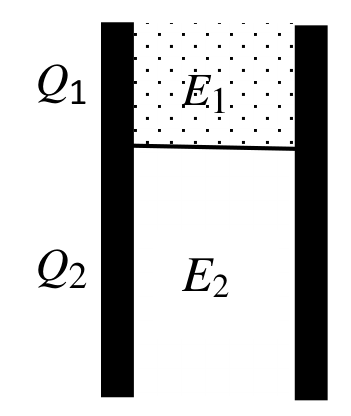
Consider a parallel plate capacitor containing a dielectric slab with dielectric constant covering of its plate area, as illustrated in the figure. Let represent the overall capacitance of the capacitor and represent the capacitance of the region occupied by the dielectric. Upon charging the capacitor, the region with dielectric acquires a charge , while the remaining area holds a charge . The electric field inside the dielectric region is , and in the dielectric-free region it is . Ignoring edge effects, select the correct statement(s).
Options
Step-by-Step Solution
To determine the correct options, we analyze the setup of the parallel plate capacitor with a partially inserted dielectric slab.
1. Equivalent Capacitor Circuit Model
The dielectric slab of dielectric constant covers a fraction of of the total plate area and extends through the entire separation distance between the parallel plates. This setup can be modeled as two individual capacitors connected in parallel across the same potential difference :
-
Region 1 (with dielectric):
- Area:
- Distance between plates:
- Dielectric constant:
- Capacitance :
-
Region 2 (dielectric-free/vacuum):
- Area:
- Distance between plates:
- Dielectric constant:
- Capacitance :
2. Electric Field Analysis
Since both regions share the same potential difference across the common distance , the uniform electric field in each region is given by:
Taking the ratio of the electric fields:
Thus, Option (A) is correct and Option (B) is incorrect.
3. Total Capacitance and Ratio
The total capacitance of the parallel combination is the sum of the individual capacitances:
Taking the ratio of total capacitance to the dielectric portion capacitance :
Thus, Option (D) is correct.
4. Charge Distribution and Ratio
The charges acquired by each portion under potential difference are:
Taking the ratio of the charges:
Thus, Option (C) is incorrect.
Conclusion
regions with the same potential difference yield and .
Correct Options: A and D