Orbital Speed in Spherically Symmetric Mass Distribution
A spherically symmetric gravitational system of particles has a mass density
where is a constant. A test mass can undergo circular motion under the influence of the gravitational field of particles. Its speed as a function of distance () from the centre of the system is represented by
Options
Topics & Concepts
Step-by-Step Solution
To find the orbital speed of a test mass as a function of the radial distance from the centre of the spherically symmetric system, we consider the gravitational force acting as the centripetal force required for circular motion:
which simplifies to:
where is the total mass enclosed within a sphere of radius .
Case 1: Inside the sphere ()
Since the mass density is uniform with :
Substituting into the expression for orbital speed:
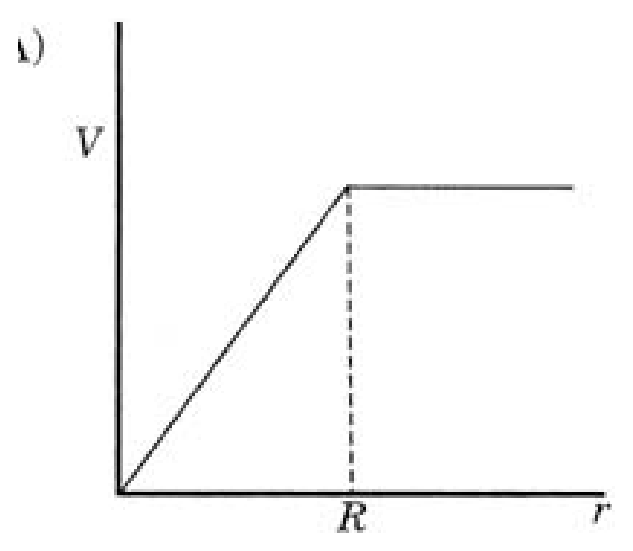
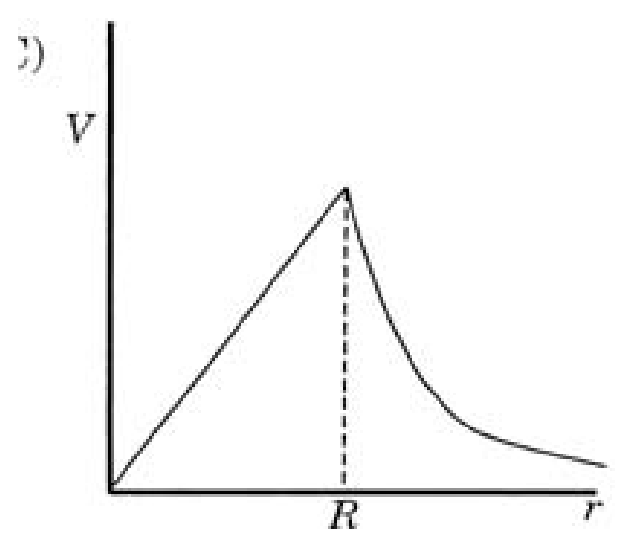
Thus, inside the sphere, the speed is directly proportional to the radius:
This corresponds to a straight line passing through the origin.
Case 2: Outside the sphere ()
Since for , the total enclosed mass remains constant and is equal to the total mass of the sphere:
Substituting into the expression for orbital speed:
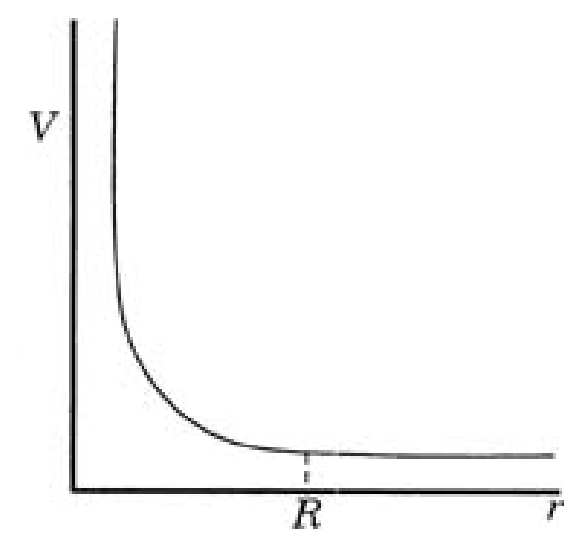
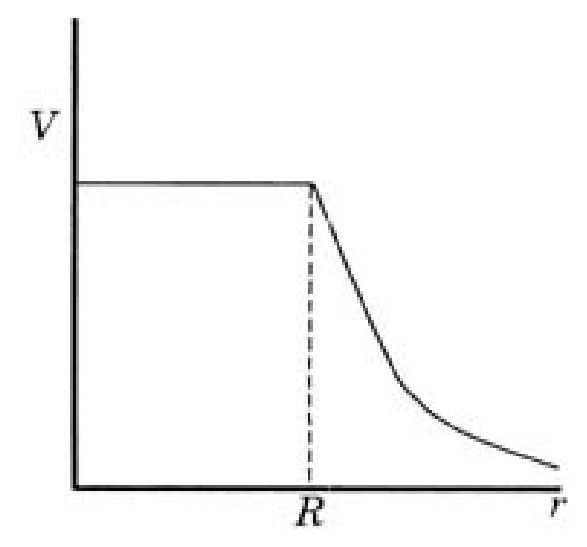
Thus, for , decreases non-linearly, approaching zero asymptotically as .
Conclusion:
- For , increases linearly with .
- For , decreases as .
This behavior matches the graph represented in Option (C).