Orbital Overlap Types and Characteristics Matching
Match the orbital overlap representations shown in List-I with the corresponding description provided in List-II and select the correct option using the codes given below:
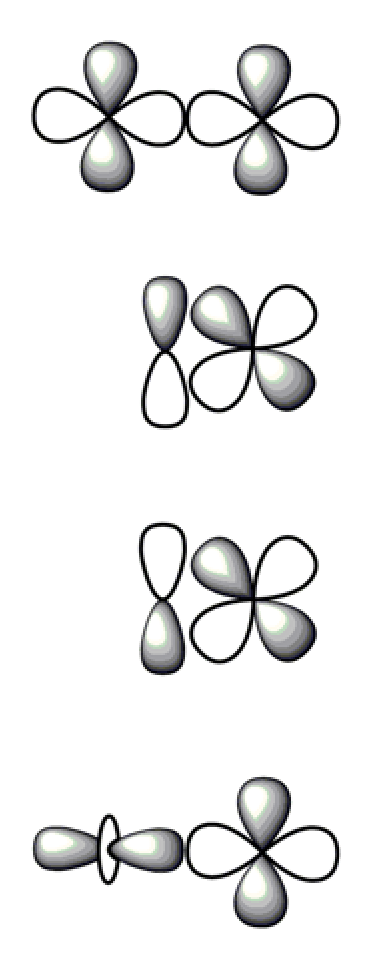
Options
A
P 2, Q 1, R 3, S 4
B
P 4, Q 3, R 1, S 2
CCorrect
P 2, Q 3, R 1, S 4
D
P 4, Q 1, R 3, S 2
Topics & Concepts
Step-by-Step Solution
To determine the correct match between the orbital overlap representations in List-I and their descriptions in List-II, we analyze the symmetry, type of orbitals involved, and the phase relationship (bonding vs. antibonding) for each representation:
-
Analysis of Figure P:
- Type of orbitals: Two -orbitals approach each other along the internuclear axis (end-on/axial overlap), which leads to a molecular orbital.
- Phase of overlapping lobes: The overlapping lobes pointing toward each other have the same phase (identical shading), representing constructive overlap without a nodal plane perpendicular to the internuclear axis.
- Conclusion: Figure P represents bonding ().
-
Analysis of Figure Q:
- Type of orbitals: A two-lobed -orbital and a four-lobed -orbital overlap sideways (lateral overlap), parallel to each other. Lateral overlap results in a -type molecular orbital.
- Phase of overlapping lobes: The lobes of the -orbital and the corresponding lobes of the -orbital that overlap have the same phase (the upper lobes share the same shade, and the lower lobes share the same shade). This constructive interference leads to a bonding interaction.
- Conclusion: Figure Q represents bonding ().
-
Analysis of Figure R:
- Type of orbitals: A -orbital and a -orbital overlap laterally, forming a -type interaction.
- Phase of overlapping lobes: The overlapping adjacent lobes possess opposite phases (opposite shading: upper shaded with upper unshaded, and lower unshaded with lower shaded). This destructive interference creates a nodal plane between the two nuclei perpendicular to the internuclear axis.
- Conclusion: Figure R represents antibonding ().
-
Analysis of Figure S:
- Type of orbitals: Two -orbitals (specifically orbitals characterized by their central toroid/doughnut ring) overlap axially along the internuclear axis, forming a interaction.
- Phase of overlapping lobes: The two main lobes facing each other along the internuclear axis have opposite phases (one is shaded, the other is unshaded), resulting in destructive interference with a nodal plane perpendicular to the bond axis.
- Conclusion: Figure S represents antibonding ().
Matching the pairs:
This matches Option (C).