Number of Hydroxyl Groups in Hydrogenated and Hydroxylated Major Product
Determine the total number of hydroxyl groups present in a molecule of the major product obtained from the following reaction sequence:
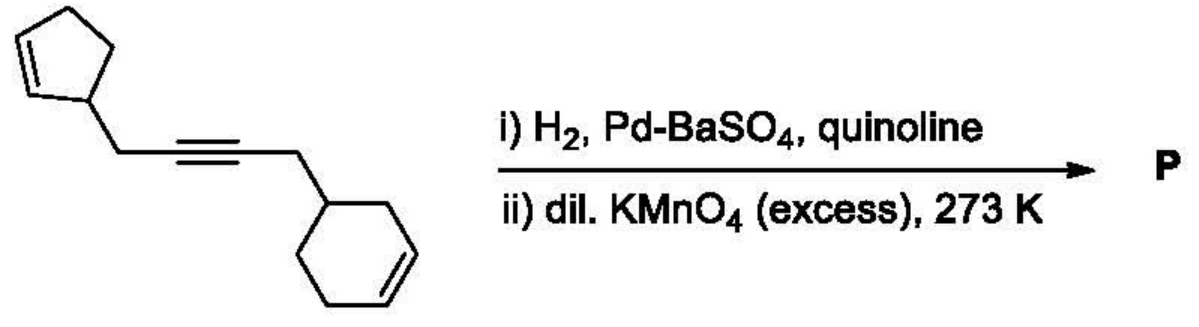
Step-by-Step Solution
To find the total number of hydroxyl groups present in a molecule of the major product , we analyze the two steps of the reaction sequence:
-
Step 1: Selective Hydrogenation using Lindlar's Catalyst Lindlar's catalyst selectively reduces alkynes to -alkenes (cis-alkenes) without reducing the existing carbon-carbon double bonds () in the molecule.
- The reactant has one internal alkyne group () and two alkene double bonds (one in the cyclopentenyl ring and one in the cyclohexenyl ring).
- Therefore, the alkyne is stereoselectively reduced to a cis-alkene:
- After this step, the intermediate contains a total of carbon-carbon double bonds:
- in the 5-membered ring
- in the acyclic chain (formed from the alkyne)
- in the 6-membered ring
-
Step 2: Dihydroxylation using Baeyer's Reagent Cold, dilute alkaline (Baeyer's reagent) carries out syn-dihydroxylation across carbon-carbon double bonds, converting each bond into a vicinal diol (adding hydroxyl groups per double bond): Since is present in excess, all double bonds undergo dihydroxylation:
Therefore, the total number of hydroxyl groups present in a molecule of the major product is 6.