Number of Electrons in Floating Oil Drop Millikan Experiment
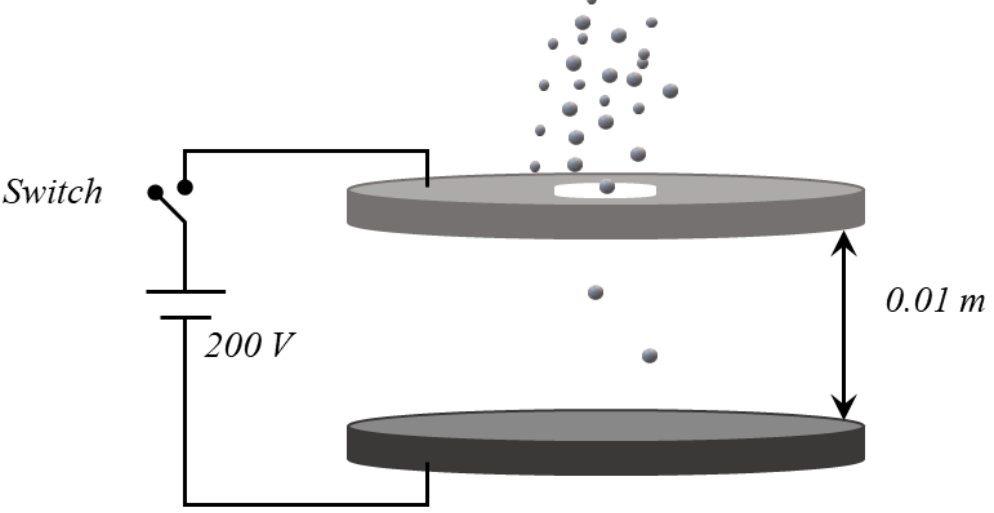
As shown in the given figure, two large circular plates separated by are attached to a voltage source via a switch. Charged oil droplets with a density of enter through a small aperture at the center of the upper disc. After reaching terminal velocity, the switch is closed, establishing a potential difference of between the plates. Consequently, a specific oil droplet of radius remains stationary and floats between the plates. Determine the total number of electrons on this drop. (Ignore buoyancy; take and elementary charge ).
Topics & Concepts
Step-by-Step Solution
To find the total number of electrons present on the floating oil drop, we analyze the forces acting on the drop at equilibrium.
1. Forces Acting on the Oil Drop
When the switch is closed, an electric field is established between the circular plates. For the oil drop to remain stationary and float, the downward gravitational force () must be balanced by the upward electrostatic force ().
-
Gravitational Force (): where:
- Density of oil,
- Volume of the spherical drop,
- Acceleration due to gravity,
- Radius of the drop,
Substituting the given values into the volume equation:
Thus, the mass of the drop is:
The gravitational force is:
-
Electrostatic Force (): where:
- is the total number of electrons
- is the elementary charge
- Electric field,
Substituting and :
2. Condition for Equilibrium
Equating the upward electrostatic force to the downward gravitational force:
Solving for :
Using :
Since the number of electrons must be an integer, rounding to the nearest whole number yields:
Final Answer: The total number of electrons on the drop is 6.