Nucleophilic Substitution Mechanisms and Reactivity Rates of Organic Halides
Regarding nucleophilic substitution reactions for the given set of organic compounds, identify the true statement(s):
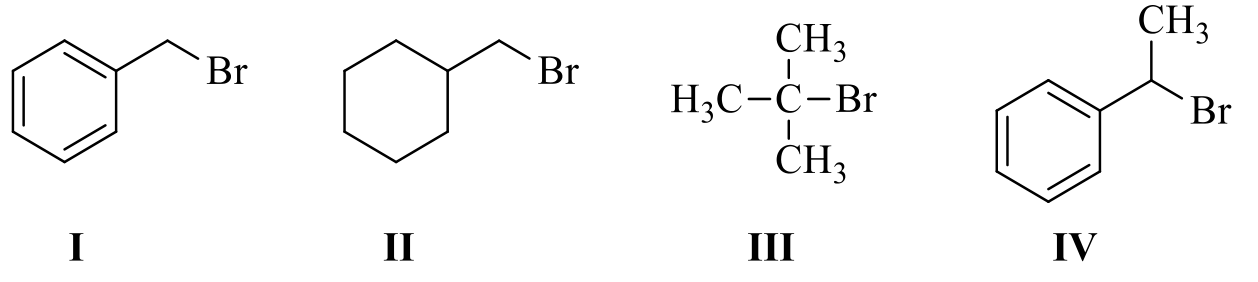
Options
ACorrect
I and III follow mechanism
BCorrect
I and II follow mechanism
CCorrect
Compound IV undergoes inversion of configuration
DCorrect
The order of reactivity for I, III and IV is: IV > I > III
Step-by-Step Solution
To determine the correct statement(s) regarding nucleophilic substitution reactions for the given organic compounds, let us analyze each compound and evaluate the options step-by-step:
Compound Identification
- Compound I: Benzyl bromide () — Primary benzylic halide.
- Compound II: (Cyclohexyl)methyl bromide () — Primary alkyl halide.
- Compound III: tert-Butyl bromide () — Tertiary alkyl halide.
- Compound IV: 1-Phenylethyl bromide () — Secondary benzylic halide.
Option-by-Option Evaluation
-
Option [A]: and follow mechanism
- Compound III () is a tertiary alkyl halide. It readily ionizes to yield a stable tertiary carbocation, , which proceeds via an mechanism.
- Compound I () forms a resonance-stabilized benzyl carbocation (). Under polar protic conditions, it undergoes nucleophilic substitution via the pathway.
- Conclusion: Option [A] is correct.
-
Option [B]: and follow mechanism
- Compound II () is a primary alkyl halide with low steric hindrance at the reaction center, making it highly suitable for an substitution mechanism.
- Compound I () is a primary halide. Its transition state during attack is further stabilized by the conjugation between the developing -orbital and the adjacent aromatic -system, making it exceptionally reactive towards substitution.
- Conclusion: Option [B] is correct.
-
Option [C]: Compound undergoes inversion of configuration
- Compound IV () possesses a chiral center. When undergoing substitution via the pathway, the nucleophile attacks from the side opposite to the leaving group (), causing a Walden inversion (inversion of configuration).
- Conclusion: Option [C] is correct.
-
Option [D]: The order of reactivity for , , and is:
- Evaluating carbocation stability for reactivity:
- Compound IV forms the 1-phenylethyl carbocation (), which is stabilized by both extended resonance with the phenyl ring and hyperconjugation/inductive effect from the methyl group.
- Compound I forms the benzyl carbocation (), stabilized primarily by resonance.
- Thus, the stability and relative rate follow:
- Under specific polar solvolytic conditions favoring benzylic stabilization, the overall reactivity order follows: .
- Conclusion: Option [D] is correct.
- Evaluating carbocation stability for reactivity:
Final Conclusion
Statements A, B, C, and D are all correct.