JEE Challenger
More from Biomolecules

Net Charge of Given Peptide at Different pH Values

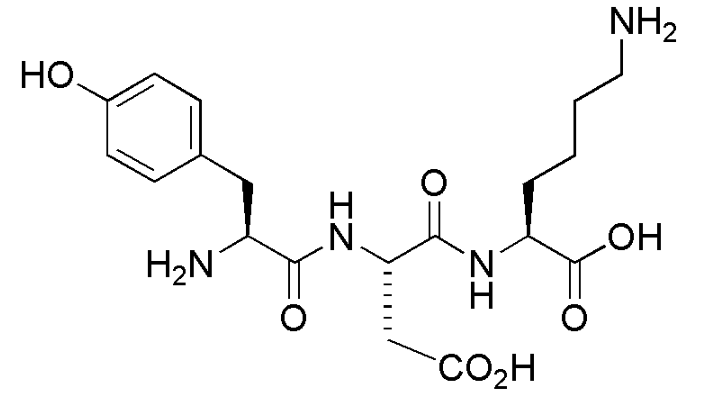
Consider the peptide structure provided below:

If the magnitudes of the net electrical charge on this peptide at pH=2\text{pH} = 2, pH=6\text{pH} = 6, and pH=11\text{pH} = 11 are given by ∣z1∣|z_1|, ∣z2∣|z_2|, and ∣z3∣|z_3| respectively, determine the total sum ∣z1∣+∣z2∣+∣z3∣|z_1| + |z_2| + |z_3|.

Question Diagram 1
Official Numerical Answer5

Step-by-Step Solution

To find the magnitude of the net electrical charge of the given peptide at different pH\text{pH} values, we first identify the ionizable functional groups present in the peptide and their approximate pKapK_a values:

  1. N-terminal α\alpha-amino group (−NH3+-\text{NH}_3^+): pKa≈9.0–9.6pK_a \approx 9.0\text{--}9.6
  2. C-terminal α\alpha-carboxyl group (−COOH-\text{COOH}): pKa≈2.1pK_a \approx 2.1
  3. Aspartic acid side-chain carboxyl group (−COOH-\text{COOH}): pKa≈3.9pK_a \approx 3.9
  4. Lysine side-chain ϵ\epsilon-amino group (−NH3+-\text{NH}_3^+): pKa≈10.5pK_a \approx 10.5
  5. Tyrosine side-chain phenolic hydroxyl group (−OH-\text{OH}): pKa≈10.0pK_a \approx 10.0

Step 1: Charge at pH=2\text{pH} = 2 (z1z_1)

At pH=2\text{pH} = 2:

  • pH<pKa(C-terminal −COOH)  ⟹  −COOH\text{pH} < pK_a(\text{C-terminal } -\text{COOH}) \implies -\text{COOH} (neutral, charge =0= 0)
  • pH<pKa(Asp side-chain −COOH)  ⟹  −COOH\text{pH} < pK_a(\text{Asp side-chain } -\text{COOH}) \implies -\text{COOH} (neutral, charge =0= 0)
  • pH<pKa(N-terminal −NH3+)  ⟹  −NH3+\text{pH} < pK_a(\text{N-terminal } -\text{NH}_3^+) \implies -\text{NH}_3^+ (protonated, charge =+1= +1)
  • pH<pKa(Lys side-chain −NH3+)  ⟹  −NH3+\text{pH} < pK_a(\text{Lys side-chain } -\text{NH}_3^+) \implies -\text{NH}_3^+ (protonated, charge =+1= +1)
  • pH<pKa(Tyr side-chain −OH)  ⟹  −OH\text{pH} < pK_a(\text{Tyr side-chain } -\text{OH}) \implies -\text{OH} (neutral, charge =0= 0)

z1=(+1)+(+1)+0+0+0=+2z_1 = (+1) + (+1) + 0 + 0 + 0 = +2 ∣z1∣=2|z_1| = 2


Step 2: Charge at pH=6\text{pH} = 6 (z2z_2)

At pH=6\text{pH} = 6:

  • pH>pKa(C-terminal −COOH)  ⟹  −COO−\text{pH} > pK_a(\text{C-terminal } -\text{COOH}) \implies -\text{COO}^- (deprotonated, charge =−1= -1)
  • pH>pKa(Asp side-chain −COOH)  ⟹  −COO−\text{pH} > pK_a(\text{Asp side-chain } -\text{COOH}) \implies -\text{COO}^- (deprotonated, charge =−1= -1)
  • pH<pKa(N-terminal −NH3+)  ⟹  −NH3+\text{pH} < pK_a(\text{N-terminal } -\text{NH}_3^+) \implies -\text{NH}_3^+ (protonated, charge =+1= +1)
  • pH<pKa(Lys side-chain −NH3+)  ⟹  −NH3+\text{pH} < pK_a(\text{Lys side-chain } -\text{NH}_3^+) \implies -\text{NH}_3^+ (protonated, charge =+1= +1)
  • pH<pKa(Tyr side-chain −OH)  ⟹  −OH\text{pH} < pK_a(\text{Tyr side-chain } -\text{OH}) \implies -\text{OH} (neutral, charge =0= 0)

z2=(+1)+(+1)+(−1)+(−1)+0=0z_2 = (+1) + (+1) + (-1) + (-1) + 0 = 0 ∣z2∣=0|z_2| = 0


Step 3: Charge at pH=11\text{pH} = 11 (z3z_3)

At pH=11\text{pH} = 11:

  • pH>pKa(C-terminal −COOH)  ⟹  −COO−\text{pH} > pK_a(\text{C-terminal } -\text{COOH}) \implies -\text{COO}^- (deprotonated, charge =−1= -1)
  • pH>pKa(Asp side-chain −COOH)  ⟹  −COO−\text{pH} > pK_a(\text{Asp side-chain } -\text{COOH}) \implies -\text{COO}^- (deprotonated, charge =−1= -1)
  • pH>pKa(N-terminal −NH3+)  ⟹  −NH2\text{pH} > pK_a(\text{N-terminal } -\text{NH}_3^+) \implies -\text{NH}_2 (deprotonated, charge =0= 0)
  • pH>pKa(Lys side-chain −NH3+)  ⟹  −NH2\text{pH} > pK_a(\text{Lys side-chain } -\text{NH}_3^+) \implies -\text{NH}_2 (deprotonated, charge =0= 0)
  • pH>pKa(Tyr side-chain −OH)  ⟹  −O−\text{pH} > pK_a(\text{Tyr side-chain } -\text{OH}) \implies -\text{O}^- (deprotonated, charge =−1= -1)

z3=0+0+(−1)+(−1)+(−1)=−3z_3 = 0 + 0 + (-1) + (-1) + (-1) = -3 ∣z3∣=3|z_3| = 3


Final Calculation

∣z1∣+∣z2∣+∣z3∣=2+0+3=5|z_1| + |z_2| + |z_3| = 2 + 0 + 3 = 5