Multi Step Reaction Sequence Involving Aniline Derivatives and Phenols
In the following reaction sequence, , , and are the major products.
The correct statement(s) about , , and is(are)
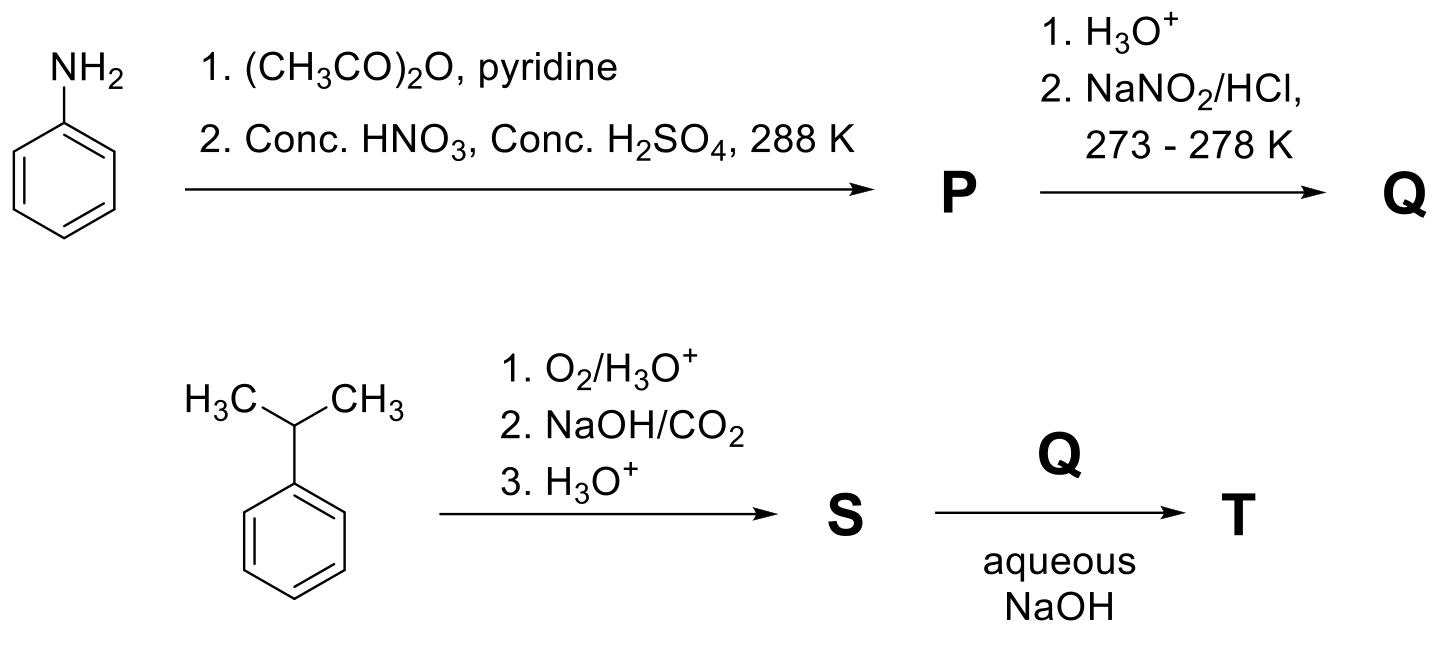
Options
on treatment with ethanol generates an aromatic aldehyde.
gives positive phthalein dye test.
is a dinitro compound.
is a coloured compound.
Topics & Concepts
Step-by-Step Solution
To determine the correct statements regarding the products , , , and , let us analyze the reaction steps sequentially:
1. Analysis of Reaction Sequence for and
-
Step 1: Aniline () reacts with acetic anhydride () in pyridine to form acetanilide () by protecting the group.
-
Step 2: Nitration of acetanilide with concentrated and concentrated at yields -nitroacetanilide as the major product , because the bulky group directs incoming electrophiles predominantly to the less sterically hindered para-position. Since product contains only one nitro group, it is a mononitro compound. Thus, Option (C) is incorrect.
-
Step 3: Hydrolysis () of removes the acetyl protecting group to give -nitroaniline ().
-
Step 4: Diazotization of -nitroaniline with at converts the amino group into a diazonium salt:
-
Reaction of with Ethanol: When -nitrobenzenediazonium chloride () is treated with ethanol (), it undergoes reduction to form nitrobenzene, while ethanol is oxidized to acetaldehyde (): Since acetaldehyde is an aliphatic aldehyde (not an aromatic aldehyde), Option (A) is incorrect.
2. Analysis of Reaction Sequence for and
-
Step 1: Cumene () undergoes aerobic oxidation followed by acidic workup () via the cumene hydroperoxide process to produce phenol () and acetone.
-
Step 2: Phenol reacts with and followed by acidification () via the Kolbe-Schmitt reaction to form salicylic acid (-hydroxybenzoic acid) as the major product :
-
Phthalein Dye Test for : Salicylic acid (), being a phenolic compound containing an active aromatic ring with a free phenolic group, condenses with phthalic anhydride in the presence of concentrated to form a phthalein dye, giving a positive phthalein dye test. Thus, Option (B) is correct.
-
Formation of Product : Electrophilic aromatic substitution (diazo coupling reaction) of -nitrobenzenediazonium chloride () with salicylic acid () in aqueous alkaline medium () yields an azo dye : Azo compounds possess an extended conjugated -electron system across the linkage, causing strong light absorption in the visible spectrum. Hence, is an intensely coloured compound. Thus, Option (D) is correct.
Conclusion
The correct statements are (B) and (D).