JEE Challenger
More from Electromagnetic Induction

Motion of Thin Conducting Rod Falling Under Gravity in Magnetic Field

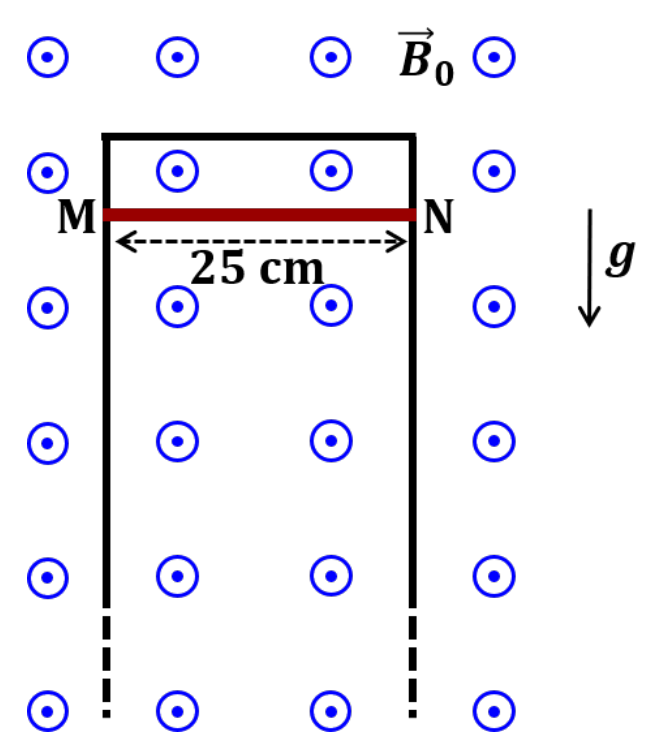
A thin conducting rod MN of mass 20 gm20\text{ gm}, length 25 cm25\text{ cm} and resistance 10 Ω10\ \Omega is held on frictionless, long, perfectly conducting vertical rails as shown in the figure. There is a uniform magnetic field B0=4 TB_0 = 4\text{ T} directed perpendicular to the plane of the rod-rail arrangement. The rod is released from rest at time t=0t = 0 and it moves down along the rails. Assume air drag is negligible. Match each quantity in List-I with an appropriate value from List-II, and choose the correct option.

[Given: The acceleration due to gravity g=10 m s2g = 10\text{ m s}^{-2} and e1=0.4e^{-1} = 0.4]

List-IList-II(P) At t=0.2 s, the magnitude of the induced emf in Volt(1) 0.07(Q) At t=0.2 s, the magnitude of the magnetic force in Newton(2) 0.14(R) At t=0.2 s, the power dissipated as heat in Watt(3) 1.20(S) The magnitude of terminal velocity of the rod in m s1(4) 0.12(5) 2.00\begin{array}{ll} \textbf{List-I} & \textbf{List-II} \\ (P)\ \text{At } t = 0.2\text{ s, the magnitude of the induced emf in Volt} & (1)\ 0.07 \\ (Q)\ \text{At } t = 0.2\text{ s, the magnitude of the magnetic force in Newton} & (2)\ 0.14 \\ (R)\ \text{At } t = 0.2\text{ s, the power dissipated as heat in Watt} & (3)\ 1.20 \\ (S)\ \text{The magnitude of terminal velocity of the rod in m s}^{-1} & (4)\ 0.12 \\ & (5)\ 2.00 \end{array}
Question Diagram 1

Options

A

P5,Q2,R3,S1P \rightarrow 5, Q \rightarrow 2, R \rightarrow 3, S \rightarrow 1

B

P3,Q1,R4,S5P \rightarrow 3, Q \rightarrow 1, R \rightarrow 4, S \rightarrow 5

C

P4,Q3,R1,S2P \rightarrow 4, Q \rightarrow 3, R \rightarrow 1, S \rightarrow 2

D

P3,Q4,R2,S5P \rightarrow 3, Q \rightarrow 4, R \rightarrow 2, S \rightarrow 5

Correct

Step-by-Step Solution

To find the correct matching between List-I and List-II, we analyze the motion of the thin conducting rod falling vertically under gravity in a uniform magnetic field.

1. Equation of Motion

Given parameters:

  • Mass of the rod, m=20 g=0.02 kgm = 20\text{ g} = 0.02\text{ kg}
  • Length of the rod, l=25 cm=0.25 ml = 25\text{ cm} = 0.25\text{ m}
  • Resistance, R=10 ΩR = 10\ \Omega
  • Magnetic field, B0=4 TB_0 = 4\text{ T}
  • Acceleration due to gravity, g=10 m s2g = 10\text{ m s}^{-2}
  • e1=0.4e^{-1} = 0.4

When the rod falls with a velocity v(t)v(t), an electromotive force (emf) is induced across its length: E=B0lv\mathcal{E} = B_0 l v

The current induced in the closed loop is given by Ohm's Law: I=ER=B0lvRI = \frac{\mathcal{E}}{R} = \frac{B_0 l v}{R}

This current experiences an upward magnetic force (Lenz's Law): Fm=IlB0=B02l2vRF_m = I l B_0 = \frac{B_0^2 l^2 v}{R}

Applying Newton's second law for the downward motion: mdvdt=mgFm=mgB02l2vRm \frac{dv}{dt} = mg - F_m = mg - \frac{B_0^2 l^2 v}{R}

Rewriting the equation: dvdt=gB02l2mRv\frac{dv}{dt} = g - \frac{B_0^2 l^2}{m R} v

We define the characteristic time constant τ\tau as: τ=mRB02l2\tau = \frac{m R}{B_0^2 l^2}

Substituting the given values: B0l=4×0.25=1 TmB_0 l = 4 \times 0.25 = 1\text{ T}\cdot\text{m} τ=0.02×1012=0.2 s\tau = \frac{0.02 \times 10}{1^2} = 0.2\text{ s}

Integrating the differential equation with initial condition v(0)=0v(0) = 0: v(t)=vT(1et/τ)v(t) = v_T \left(1 - e^{-t/\tau}\right)

where vT=gτv_T = g \tau is the terminal velocity of the rod.


2. Calculation of Quantities

(S) Terminal Velocity (vTv_T)

vT=gτ=10×0.2=2.00 m s1v_T = g \tau = 10 \times 0.2 = 2.00\text{ m s}^{-1} Thus, S5S \rightarrow 5.

Velocity at t=0.2 st = 0.2\text{ s}

At t=0.2 s=τt = 0.2\text{ s} = \tau: v(0.2)=vT(1e1)=2.00×(10.4)=1.20 m s1v(0.2) = v_T \left(1 - e^{-1}\right) = 2.00 \times (1 - 0.4) = 1.20\text{ m s}^{-1}

(P) Induced EMF at t=0.2 st = 0.2\text{ s}

E=B0lv(0.2)=1×1.20=1.20 V\mathcal{E} = B_0 l v(0.2) = 1 \times 1.20 = 1.20\text{ V} Thus, P3P \rightarrow 3.

(Q) Magnitude of Magnetic Force at t=0.2 st = 0.2\text{ s}

Fm=B02l2v(0.2)R=12×1.2010=0.12 NF_m = \frac{B_0^2 l^2 v(0.2)}{R} = \frac{1^2 \times 1.20}{10} = 0.12\text{ N} Thus, Q4Q \rightarrow 4.

(R) Power Dissipated as Heat at t=0.2 st = 0.2\text{ s}

Pheat=E2R=(1.20)210=1.4410=0.144 W0.14 WP_{\text{heat}} = \frac{\mathcal{E}^2}{R} = \frac{(1.20)^2}{10} = \frac{1.44}{10} = 0.144\text{ W} \approx 0.14\text{ W} Thus, R2R \rightarrow 2.


Conclusion

The correct match is: P3, Q4, R2, S5P \rightarrow 3,\ Q \rightarrow 4,\ R \rightarrow 2,\ S \rightarrow 5

This corresponds to Option D.