Motion of Square Loop Entering Magnetic Field Region
A conducting square loop of side , mass and resistance is moving in the plane with its edges parallel to the and axes. The region has a uniform magnetic field, . The magnetic field is zero everywhere else. At time , the loop starts to enter the magnetic field with an initial velocity , as shown in the figure. Considering the quantity in appropriate units, ignoring self-inductance of the loop and gravity, which of the following statements is/are correct:
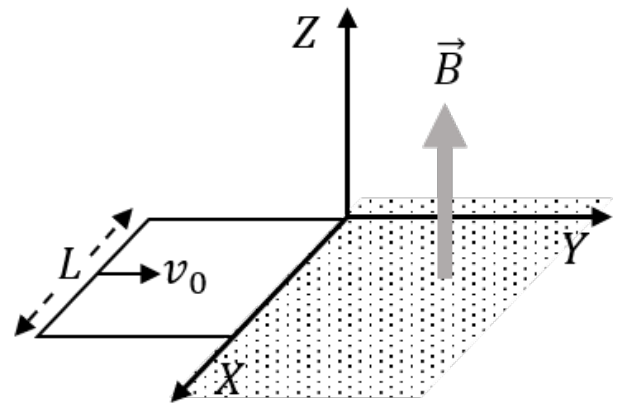
Options
If , the loop will stop before it enters completely inside the region of magnetic field.
When the complete loop is inside the region of magnetic field, the net force acting on the loop is zero.
If , the loop comes to rest at .
If , the complete loop enters inside the region of magnetic field at time .
Topics & Concepts
Step-by-Step Solution
To determine which statements are correct, we analyze the motion of the conducting square loop as it enters the magnetic field region .
1. Equation of Motion
Let be the displacement of the leading edge of the loop inside the magnetic field region ().
As the loop enters the magnetic field with velocity , the magnetic flux through the loop is:
The magnitude of the induced electromotive force (EMF) is given by Faraday's law:
The induced current in the loop of resistance is:
By Lenz's law, this current causes a magnetic force that opposes the motion. The magnetic force acts on the leading edge of length :
Using Newton's second law, :
Given , the differential equation for velocity becomes:
2. Velocity as a Function of Position and Time
From equation (1), expressing :
Integrating with initial conditions at :
Integrating equation (1) with respect to time :
The position as a function of time is:
3. Evaluation of Options
-
Option A: If the loop stops at distance , then setting in equation (2): For : Since , the loop reaches with a non-zero velocity () and completely enters the field region without stopping inside . Thus, Option A is incorrect.
-
Option B: When the entire loop is inside the region , the magnetic flux through the loop is constant (). Therefore, , so no current is induced (). With no induced current, the net magnetic force on the loop is zero. Thus, Option B is correct.
-
Option C: From equation (3), the velocity decays exponentially: . The loop comes to rest () asymptotically as , not at any finite time . Thus, Option C is incorrect.
-
Option D: To find the time when the complete loop enters the magnetic field region (), we set in equation (4): Given : Taking the natural logarithm on both sides: Thus, Option D is correct.
Conclusion
The correct options are B and D.