Monobromination Chiral Products Count for Enantiomerically Pure Alkane
In the monobromination reaction depicted below, calculate the total number of possible chiral products that are formed:
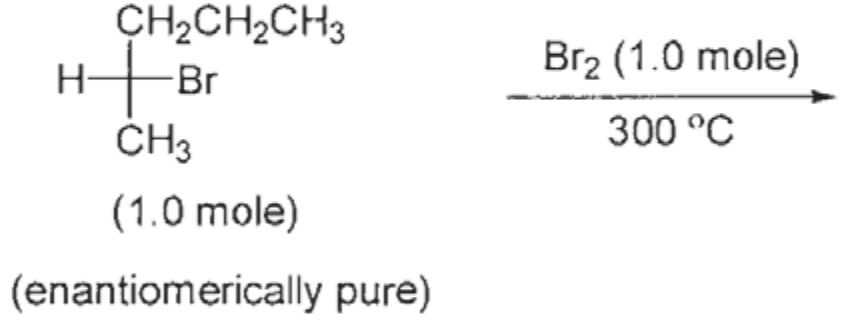
Official Numerical Answer5
Topics & Concepts
Step-by-Step Solution
To determine the total number of chiral products formed during the monobromination of enantiomerically pure 2-bromopentane, we analyze the reaction at each position along the pentane carbon chain.
Let the starting material be -2-bromopentane, where the carbon atom C2 has a fixed configuration.
1. Monobromination at C1 ( group)
- Product: 1,2-dibromopentane ()
- Chirality Analysis:
- C2 retains its stereochemistry ().
- C1 has two hydrogen atoms and is achiral.
- Chiral Products Count: 1 (a single enantiomer)
2. Monobromination at C2 ( group)
- Product: 2,2-dibromopentane ()
- Chirality Analysis:
- C2 now has two identical bromine atoms, destroying the chiral center.
- Chiral Products Count: 0 (achiral product)
3. Monobromination at C3 ( group)
- Product: 2,3-dibromopentane ()
- Chirality Analysis:
- C2 retains its configuration ().
- Reaction at C3 proceeds via a planar -hybridized free radical intermediate, allowing attack from both faces to give both and configurations.
- This generates two diastereomers: and .
- Since the two terminal groups attached to the C2 and C3 chiral centers are different ( vs. ), the molecule lacks symmetry, meaning no meso form exists.
- Chiral Products Count: 2
4. Monobromination at C4 ( group)
- Product: 2,4-dibromopentane ()
- Chirality Analysis:
- C2 retains its configuration ().
- Monobromination at C4 via a planar free radical creates a new chiral center at C4, forming two diastereomers: and .
- 2,4-dibromopentane is a symmetrical molecule. The isomer contains an internal plane of symmetry passing through C3 and is an achiral (meso) compound.
- The isomer has no plane or center of symmetry and is chiral.
- Chiral Products Count: 1
5. Monobromination at C5 ( group)
- Product: 1,4-dibromopentane ()
- Chirality Analysis:
- C2 retains its configuration ().
- C5 has two hydrogen atoms and is achiral.
- Chiral Products Count: 1
Total Calculation:
The total number of possible chiral products is 5.